Ecosistemi socio-circolari – Innovazione sociale, strategie circolari e ambiente costruito
DOI:
https://doi.org/10.69143/2464-9309/19112026Parole chiave:
economia circolare, condivisione delle risorse, valore sociale, ecosistema socio-circolare, modelli abitativi e insediativiAbstract
Sebbene le metriche ambientali ed economiche della circolarità siano consolidate, la sua dimensione sociale resta poco sistematizzata. Le politiche europee riconoscono il ruolo della transizione circolare nei processi di inclusione, equità e benessere, ma in letteratura il valore sociale della circolarità è spesso ricondotto ad ambiti come edilizia sociale, co-progettazione e imprese sociali. Il paper propone il concetto di Ecosistema Socio-Circolare (SCE), inteso come sistema spaziale e relazionale in cui attori a diverse scale condividono e cogestiscono risorse tangibili e intangibili. Applicato a casi europei tale quadro interpretativo consente di riconoscere configurazioni organizzative e spaziali degli SCE e di attivare processi circolari, generare valore sociale e sviluppare nuovi modelli abitativi e insediativi.
Info sull'articolo
Ricevuto: 11/03/2026; Revisionato: 13/04/2026; Accettato: 14/04/2026
Downloads
##plugins.generic.articleMetricsGraph.articlePageHeading##
Riferimenti bibliografici
Aarikka-Stenroos, L., Ritala, P. and Thomas, L. D. W. (2021), “Circular economy ecosystems – A typology, definitions, and implications”, in Teerikangas, S., Onkila, T., Koistinen, K. and Mäkelä, M. (eds), Research Handbook of Sustainability Agen-cy, Edward Elgar Publishing, Cheltenham, pp. 260-276. [Online] Available at: doi.org/10.4337/9781789906035.00024 [Ac-cessed 10 March 2026].
Abdalla, S., Amankwah-Amoah, J. and Badewi, A. (2023), “Sharing-Economy Ecosystem – A Comprehensive Review and Fu-ture Research Directions”, in Sustainability, vol. 15, issue 3, article 2145, pp. 1-15. [Online] Available at: doi.org/10.3390/su15032145 [Accessed 10 March 2026].
Aldieri, L., Brahmi, M., Bruno, B. and Vinci, C. P. (2021), “Circular Economy Business Models – The Complementarities with Sharing Economy and Eco-Innovations Investments”, in Sustainability, vol. 13, issue 22, article 12438, pp. 1-13. [Online] Available at: doi.org/10.3390/su132212438 [Accessed 10 March 2026].
Aminoff, A., Valkokari, K., Antikainen, M. and Kettunen, O. (2017), “Exploring disruptive business model innovation for the circular economy”, in Campana, G., Howlett, R., Setchi, R. and Cimatti, B. (eds), Sustainable Design and Manufacturing 2017 – SDM 2017 – Selected Papers on Sustainable Design and Manufacturing, University of Bologna, Bologna, Italy, April 26-28, 2017, Smart Innovation, Systems and Technologies, vol. 68, Springer, Cham, pp. 525-536. [Online] Available at: doi.org/10.1007/978-3-319-57078-5_50 [Accessed 10 March 2025].
Arquilla, V. and Caruso, C. (2025), “Un approccio di integrazione nativa dell’inclusione nel meta-design – L’esperienza COmeta | Towards native integration of inclusivity in meta-design – The COmeta experience”, in Agathón | International Journal of Architecture, Art and Design, vol. 17, pp. 360-373. [Online] Available at: doi.org/10.69143/2464-9309/17252025 [Accessed 10 March 2026].
Aryee, R. (2024), “Conceptualising the Circular Ecosystem – An Analysis of Multiple Definitions”, in Business Strategy & Development, vol. 7, issue 4, article e70050, pp. 1-17. [Online] Available at: doi.org/10.1002/bsd2.70050 [Accessed 10 March 2026].
Asgari, A. and Asgari, R. (2021), “How circular economy transforms business models in a transition towards circular ecosys-tem – The barriers and incentives”, in Sustainable Production and Consumption, vol. 28, pp. 566-579. [Online] Available at: doi.org/10.1016/j.spc.2021.06.020 [Accessed 10 March 2026].
Atstaja, D., Koval, V., Grasis, J., Kalina, I., Kryshtal, H. and Mikhno, I. (2022), “Sharing Model in Circular Economy towards Rational Use in Sustainable Production”, in Energies, vol. 15, issue 3, article 939, pp. 1-26. [Online] Available at: doi.org/10.3390/en15030939 [Accessed 10 March 2026].
Barquete, S., Shimozono, A. H., Trevisan, A. H., Castro, C. G., Gomes, L. A. V. and Mascarenhas, J. (2022), “Exploring the dy-namic of a circular ecosystem – A case study about drivers and barriers”, in Sustainability, vol. 14, issue 13, article 7875, pp. 1-22. [Online] Available at: doi.org/10.3390/su14137875 [Accessed 10 March 2026].
Bocken, N. M. P., de Pauw, I., Bakker, C. and Van der Grinten, B. (2016), “Product design and business model strategies for a circular economy”, in Journal of Industrial and Production Engineering, vol. 33, issue 5, pp. 308-320. [Online] Available at: doi.org/10.1080/21681015.2016.1172124 [Accessed 10 March 2026].
Broer, S. and Titheridge, H. (2010), “Eco-Self-Build Housing Communities – Are They Feasible and Can They Lead to Sus-tainable and Low Carbon Lifestyles?”, in Sustainability, vol. 2, issue 7, pp. 2084-2116. [Online] Available at: doi.org/10.3390/su2072084 [Accessed 10 March 2026].
Bullinger, K. (2025), “An institutional theory perspective on social innovations for a circular built environment”, in Urban, Planning and Transport Research, vol. 13, issue 1, article 2534351, pp. 1-21. [Online] Available at: doi.org/10.1080/21650020.2025.2534351 [Accessed 10 March 2026].
Bullinger, K. and Schiller, G. (2025), “Social innovations for a circular built environment – A heuristic framework based on a review”, in PLOS | Sustainability and Transformation, vol. 4, issue 3, article e0000161, pp. 1-22. [Online] Available at: doi.org/10.1371/journal.pstr.0000161 [Accessed 10 March 2026].
Campagnaro, C., Ronsivalle, D., Di Prima, N., Curtabbi, G. and Passaro, R. (2025), “Fare e rifare – Opportunità e limiti della co-progettazione per gli spazi pubblici e di welfare | Doing and redoing – Opportunities and limits of co-design for public and welfare spaces”, in Agathón | International Journal of Architecture, Art and Design, vol. 17, pp. 310-323. [Online] Availa-ble at: doi.org/10.69143/2464-9309/17212025 [Accessed 10 March 2026].
Carreño-Ortiz, J., Escobar-Sierra, M. and Lopez-Perez, F. (2025), “Theoretical relationship between circular economy and so-cial innovation from a sustainable development perspective”, in Humanities and Social Sciences Communications, vol. 12, article 1549, pp. 1-20. [Online] Available at: doi.org/10.1057/s41599-025-05862-0 [Accessed 10 March 2026].
Crippa, D., Di Prete, B., Fagnoni, R. and Leonardi, C. (2024), “Distretti energetici collaborativi – Laboratori urbani per un’energia di prossimità | Collaborative energy districts – Urban workshops for proximity energy”, in Agathón | Internation-al Journal of Architecture, Art and Design, vol. 15, pp. 296-305. [Online] Available at: doi.org/10.19229/2464-9309/15242024 [Accessed 10 March 2026].
Cutieru, A. (2021), “Amsterdam’s Floating Neighbourhood Schoonschip Offers a New Perspective on Circularity and Resili-ency”, in ArchDaily, 28/06/2021. [Online] Available at: archdaily.com/964050/amsterdams-floating-neighbourhood-schoonschip-offers-a-new-perspective-on-circularity-and-resiliency [Accessed 10 March 2026].
Del Curto, B., Valassina, S. and Santi, R. (2025), “Materiali pro-sociali – Modelli sostenibili alimentati da un’istruzione di qualità | Pro-social materials – Sustainable models powered by quality education”, in Agathón | International Journal of Ar-chitecture, Art and Design, vol. 17, pp. 374-383. [Online] Available at: doi.org/10.69143/2464-9309/17262025 [Accessed 10 March 2026].
EEA – European Environment Agency (2024), Greenhouse gas emissions from energy use in buildings in Europe. [Online] Available at: eea.europa.eu/en/analysis/indicators/greenhouse-gas-emissions-from-energy [Accessed 15 February 2026].
EEA – European Environment Agency (2017), “Urban stormwater management in Augustenborg, Malmö”, in Climate-ADAPT, 27/06/2017. [Online] Available at: climate-adapt.eea.europa.eu/en/metadata/case-studies/urban-storm-water-management-in-augustenborg-malmo [Accessed 10 March 2026].
Eixerés Ros, J. (2025), “Habitat collettivi per la rigenerazione rurale – Una cooperativa edilizia ad Almenara (Spagna) | Collec-tive habitats for rural regeneration – A housing cooperative in Almenara (Spain)”, in Agathón | International Journal of Ar-chitecture, Art and Design, vol. 18, pp. 238-249. [Online] Available at: doi.org/10.69143/2464-9309/18132025 [Accessed 10 March 2025].
European Commission (2017), “BlueCity revitalises abandoned Rotterdam water park into circular laboratory”, in European Circular Economy Stakeholder Platform. [Online] Available at: circulareconomy.europa.eu/platform/en/good-practices/bluecity-revitalises-abandoned-rotterdam-water-park-circular-laboratory [Accessed 10 March 2026].
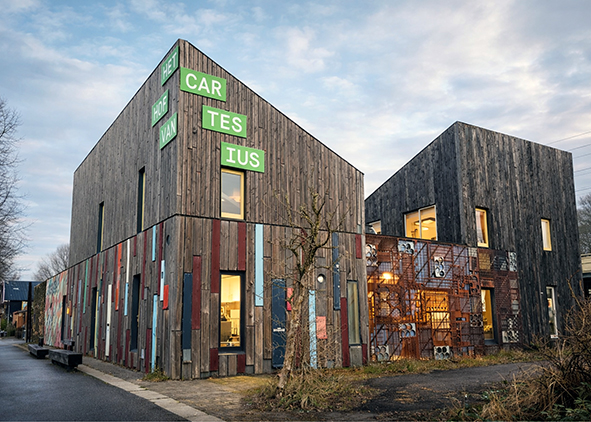
European Commission (n.d.), “Het Hof van Cartesius – The circular hotspot for circular action”, in European Circular Econ-omy Stakeholder Platform. [Online] Available at: circulareconomy.europa.eu/platform/en/good-practices/het-hof-van-cartesius-circular-hotspot-circular-action [Accessed 10 March 2026].
Frantzen, T. (2015), “PATCH22 – Highrise in wood”, in Proceedings of the 8th European Conference on Energy Efficiency and Sustainability in Architecture and Planning, pp. 1-8. [Online] Available at: events.forum-holzbau.com/pdf/30_EBH_15_Frantzen.pdf [Accessed 10 March 2026].
Frischmann, B. M. (2012), Infrastructure – The Social Value of Shared Resources, Oxford University Press, New York. [Online] Available at: doi.org/10.1093/acprof:oso/9780199895656.001.0001 [Accessed 10 March 2026].
Gaddi, R. and Mastrolonardo, L. (2024), “Micro-reti locali per la transizione verde della filiera della lana | Local micro-networks for green transition of the wool supply chain”, in Agathón | International Journal of Architecture, Art and Design, vol. 15, pp. 344-353. [Online] Available at: doi.org/10.19229/2464-9309/15292024 [Accessed 10 March 2026].
Geissdoerfer, M., Kanda, W. and Kirchherr, J. (2025), “Conceptualizing circular ecosystems – An analysis of 45 definitions”, in Business Strategy and the Environment, vol. 35, issue 2, pp. 2368-2394. [Online] Available at: doi.org/10.1002/bse.70242 [Accessed 10 March 2026].
Geissdoerfer, M., Savaget, P., Bocken, N. M. P. and Hultink, E. J. (2017), “The circular economy – A new sustainability para-digm?”, in Journal of Cleaner Production, vol. 143, pp. 757-768. [Online] Available at: doi.org/10.1016/j.jclepro.2016.12.048 [Accessed 10 March 2026].
Gkatzogias, K., Romano, E. and Negro, P. (eds) (2024), A practical guide to the New European Bauhaus self-assessment method and tool, Publications Office of the European Union, Luxembourg. [Online] Available at: doi.org/10.2760/9581060 [Accessed 10 March 2026].
Gomes, L. A. V., de Faria, A. M., Braz, A. C., de Mello, A. M., Borini, F. M. and Ometto, A. R. (2023), “Circular ecosystem man-agement – Orchestrating ecosystem value proposition and configuration”, in International Journal of Production Econom-ics, vol. 256, article 108725, pp. 1-16. [Online] Available at: doi.org/10.1016/j.ijpe.2022.108725 [Accessed 10 March 2026].
Greater London Authority (2026), UK’s first Circular Construction Hub launches in the Royal Docks, supporting Mayor’s ambition for London to be zero carbon by 2030. [Online] Available at: london.gov.uk/uks-first-circular-construction-hub-launches-royal-docks-supporting-mayors-ambition-london-be-zero [Accessed 10 March 2026].
Halleran, A. and Waldstrom, E. (2017), “People’s Pavilion”, in Circular Design Atlas. [Online] Available at: filelist.tudelft.nl/BK/Onderzoek/Onderzoeksthemas/Circular_Built_ Environment/Circular_Impuls_Initiative/Circular_Design_Atlas/Atlas_ BES2023_Peoples_Pavilion.pdf [Accessed 10 March 2026].
Henry, M., Schraven, D., Bocken, N., Frenken, K., Hekkert, M. and Kirchherr, J. (2021), “The battle of the buzzwords – A com-parative review of the circular economy and the sharing economy concepts”, in Environmental Innovation and Societal Tran-sitions, vol. 38, pp. 1-21. [Online] Available at: doi.org/10.1016/j.eist.2020.10.008 [Accessed 10 March 2026].
Iverot, S. P. and Brandt, N. (2011), “The development of a sustainable urban district in Hammarby Sjöstad, Stockholm, Swe-den?”, in Environment, Development and Sustainability, vol. 13, issue 6, pp. 1043-1064. [Online] Available at: doi.org/10.1007/s10668-011-9304-x [Accessed 10 March 2026].
Kanda, W. (2023), “Systems and ecosystems in the circular economy – What’s the difference?”, in Journal of Circular Econ-omy, vol. 1, issue 3, pp. 1-10. [Online] Available at: doi.org/10.55845/RMDN3752 [Accessed 10 March 2026].
Katrini, E. (2018), “Sharing Culture – On definitions, values, and emergence”, in The Sociological Review Monographs, vol. 66, issue 2, pp. 425-446. [Online] Available at: doi.org/10.1177/0038026118758550 [Accessed 10 March 2026].
Kenter, J. O., O’Brien, L., Hockley, N., Ravenscroft, N., Fazey, I., Irvine, K. N., Reed, M. S., Christie, M., Brady, E., Bryce, R., Church, A., Cooper, N., Davies, A., Evely, A., Everard, M., Fish, R., Fisher, J. A., Jobstvogt, N., Molloy, C., Orchard-Webb, J., Ranger, S., Ryan, M., Watson, V. and Williams, S. (2015), “What are shared and social values of ecosystems?”, in Ecological Economics, vol. 111, pp. 86-99. [Online] Available at: doi.org/10.1016/j.ecolecon.2015.01.006 [Accessed 10 March 2026].
Khadim, N., Agliata, R., Marino, A., Thaheem, M. J. and Mollo, L. (2022), “Critical review of nano and micro-level building circularity indicators and frameworks”, in Journal of Cleaner Production, vol. 357, article 131859, pp. 1-14. [Online] Avail-able at: doi.org/10.1016/j.jclepro.2022.131859 [Accessed 10 March 2026].
Kjaer, L. L., Pigosso, D. C. A., Niero, M., Bech, N. M. and McAloone, T. C. (2019), “Product/Service-Systems for a Circular Economy – The Route to Decoupling Economic Growth from Resource Consumption?”, in Journal of Industrial Ecology, vol. 23, issue 1, pp. 22-35. [Online] Available at: doi.org/10.1111/jiec.12747 [Accessed 10 March 2026].
Leung, X. Y., Xue, L. and Wen, H. (2019), “Framing the sharing economy – Toward a sustainable ecosystem”, in Tourism Management, vol. 71, pp. 44-53. [Online] Available at: doi.org/10.1016/j.tourman.2018.09.021 [Accessed 10 March 2026].
Marchesi, M. and Tweed, C. (2021), “Social innovation for a circular economy in social housing”, in Sustainable Cities and Society, vol. 71, article 102925, pp. 1-17. [Online] Available at: doi.org/10.1016/j.scs.2021.102925 [Accessed 10 March 2026].
Marchesi, M., Tweed, C. and Gerber, D. (2020), “Applying Circular Economy Principles to Urban Housing”, in Wallbaum, H., Hollberg, A. and Thuvander, L. (eds), WSBE 20 – World Sustainable Built Environment – Beyond2020, Gothenburg, Sweden, November 2-4, 2020, IOP Conference Series – Earth and Environmental Science, IOP Publishing, Bristol, vol. 588, article 052065, pp. 1-8. [Online] Available at: doi.org/10.1088/1755-1315/588/5/052065 [Accessed 10 March 2026].
Milotay, N. (2017), Fostering social innovation in the European Union, Briefing January 2017, European Parliament, Brus-sels. [Online] Available at: europarl.europa.eu/RegData/etudes/BRIE/2017/595885/EPRS_BRI(2017) 595885_EN.pdf [Ac-cessed 8 March 2026].
Moggi, S. and Dameri, R. P. (2021), “Circular business model evolution – Stakeholder matters for a self-sufficient ecosystem”, in Business Strategy and the Environment, vol. 30, issue 6, pp. 2830-2842. [Online] Available at: doi.org/10.1002/bse.2716 [Accessed 10 March 2026].
Mont, O. and Voytenko Palgan, Y. (2025), “Introduction to Understanding the Urban Sharing Economy”, in Mont, O. (ed.), Understanding the Urban Sharing Economy – Sustainability and Institutionalisation, Edward Elgar Publishing, Chelten-ham, pp. 2-23. [Online] Available at: doi.org/10.4337/9781035320547.00010 [Accessed 10 March 2026].
Olivastri, C. and Tagliasco, G. (2024), “Servizi per il riuso e il riparo – L’allestimento tra touchpoints e infrastrutture rela-zionali | Services for reuse and repair – The arrangement between touchpoints and relational infrastructures”, in Agathón | In-ternational Journal of Architecture, Art and Design, vol. 15, pp. 324-331. [Online] Available at: doi.org/10.19229/2464-9309/15272024 [Accessed 10 March 2026].
Pérez-Pérez, C. and Nebreda-Calvo, R. (2024), “The Value Creation Model in the Sharing Economy”, in González-Torres, T. and Rodríguez-Sánchez, J.-L. (eds), Promoting Value Creation Through Organizational Effectiveness and Development, IGI Global Scientific Publishing, Hershey, pp. 1-20. [Online] Available at: doi.org/10.4018/978-1-6684-8479-1.ch001 [Accessed 10 March 2026].
Petrescu, D., Petcou, C. and Baibarac, C. (2016), “Co-producing commons-based resilience – Lessons from R-Urban”, in Build-ing Research & Information, vol. 44, issue 7, pp. 717-736. [Online] Available at: doi.org/10.1080/09613218.2016.1214891 [Accessed 10 March 2026].
Pietrulla, F. (2022), “Circular ecosystems – A review”, in Cleaner and Circular Bioeconomy, vol. 3, article 100031, pp. 1-12. [Online] Available at: doi.org/10.1016/j.clcb.2022.100031 [Accessed 10 March 2026].
Quintelier, K. J. P., van Bommel, K., van Erkelens, A. M. and Wempe, J. (2023), “People at the heart of circularity – A mixed methods study about trade-offs, synergies, and strategies related to circular and social organizing”, in Journal of Cleaner Pro-duction, vol. 387, article 135780, pp. 1-11. [Online] Available at: doi.org/10.1016/j.jclepro.2022.135780 [Accessed 10 March 2026].
Rathnayake, I., Ochoa, J. J., Gu, N., Rameezdeen, R., Statsenko, L. and Sandhu, S. (2024), “A critical review of the key aspects of sharing economy – A systematic literature review and research framework”, in Journal of Cleaner Production, vol. 434, article 140378, pp. 1-23. [Online] Available at: doi.org/10.1016/j.jclepro.2023.140378 [Accessed 10 March 2026].
Semprebon, G., Santus, K., Sartorio, S. and Scaioli, A. L. N. (2021), “Progetto ed economia circolare – Architetture che rigen-erano il tessuto costruito | Design and circular economy – Architectures that regenerate the built fabric”, in Agathón | Interna-tional Journal of Architecture Art and Design, vol. 9, pp. 62-71. [Online] Available at: doi.org/10.19229/2464-9309/962021 [Accessed 10 March 2026].
Sica, G., Palazzo, M., Micozzi, A., Gigauri, I., Ključnikov, A. and Lusini, G. (2025), “The role of communities and social inno-vation in circular economy and sustainable packaging – A bibliometric perspective”, in Cogent Business & Management, vol. 12, issue 1, article 2583738, pp. 1-30. [Online] Available at: doi.org/10.1080/23311975.2025.2583738 [Accessed 10 March 2026].
Trevisan, A. H., Castro, C. G., Gomes, L. A. V. and Mascarenhas, J. (2022), “Unlocking the circular ecosystem concept – Evo-lution, current research, and future directions”, in Sustainable Production and Consumption, vol. 29, pp. 286-298. [Online] Available at: doi.org/10.1016/j.spc.2021.10.020 [Accessed 10 March 2026].
Tukker, A. (2015), “Product services for a resource-efficient and circular economy – A review”, in Journal of Cleaner Produc-tion, vol. 97, pp. 76-91. [Online] Available at: doi.org/10.1016/j.jclepro.2013.11.049 [Accessed 10 March 2026].
Uusikartano, J., Väyrynen, H. and Aarikka-Stenroos, L. (2020), “Public agency in changing industrial circular economy eco-systems – Roles, modes and structures”, in Sustainability, vol. 12, issue 23, article 10015, pp. 1-27. [Online] Available at: doi.org/10.3390/su122310015 [Accessed 10 March 2026].
Williams, J. (2023), “Circular cities – Planning for circular development in European cities”, in European Planning Studies, vol. 31, issue 1, pp. 14-35. [Online] Available at: doi.org/10.1080/09654313.2022.2060707 [Accessed 10 March 2026].
Wurster, S., Heß, P., Nauruschat, M. and Jütting, M. (2020), “Sustainable circular mobility – User-integrated innovation and specifics of electric vehicle owners”, in Sustainability, vol. 12, issue 19, article 7900, pp. 1-20. [Online] Available at: doi.org/10.3390/su12197900 [Accessed 10 March 2026].
Yu, Y., Yazan, D. M., van den Berg, M., Firdausy, D. R., Junjan, V. and Iacob, M.-E. (2023), “Circularity information platform for the built environment”, in Automation in Construction, vol. 152, article 104933, pp. 1-17. [Online] Available at: doi.org/10.1016/j.autcon.2023.104933 [Accessed 10 March 2026].
##submission.downloads##
Pubblicato
Come citare
Fascicolo
Sezione
Categorie
Licenza
Copyright (c) 2026 Cinzia Maria Luisa Talamo, Noelia Huanca Coacalla, Nazly Atta, Giancarlo Paganin

TQuesto lavoro è fornito con la licenza Creative Commons Attribuzione 4.0 Internazionale.
AGATHÓN è pubblicata sotto la licenza Creative Commons Attribution License 4.0 (CC-BY).
License scheme | Legal code
Questa licenza consente a chiunque di:
Condividere: riprodurre, distribuire, comunicare al pubblico, esporre in pubblico, rappresentare, eseguire e recitare questo materiale con qualsiasi mezzo e formato.
Modificare: remixare, trasformare il materiale e basarti su di esso per le tue opere per qualsiasi fine, anche commerciale.
Alle seguenti condizioni
Attribuzione: si deve riconoscere una menzione di paternità adeguata, fornire un link alla licenza e indicare se sono state effettuate delle modifiche; si può fare ciò in qualsiasi maniera ragionevole possibile, ma non con modalità tali da suggerire che il licenziante avalli l'utilizzatore o l'utilizzo del suo materiale.
Divieto di restrizioni aggiuntive: non si possono applicare termini legali o misure tecnologiche che impongano ad altri soggetti dei vincoli giuridici su quanto la licenza consente di fare.
Note
Non si è tenuti a rispettare i termini della licenza per quelle componenti del materiale che siano in pubblico dominio o nei casi in cui il nuovo utilizzo sia consentito da una eccezione o limitazione prevista dalla legge.
Non sono fornite garanzie. La licenza può non conferire tutte le autorizzazioni necessarie per l'utilizzo che ci si prefigge. Ad esempio, diritti di terzi come i diritti all'immagine, alla riservatezza e i diritti morali potrebbero restringere gli usi del materiale.