Floating features – Rethinking the relationships between water, energy, and labour through cultural hydrology
DOI:
https://doi.org/10.69143/2464-9309/1842025Keywords:
floating infrastructures, wetland landscapes, productive landscapes, circular economy, post-growthAbstract
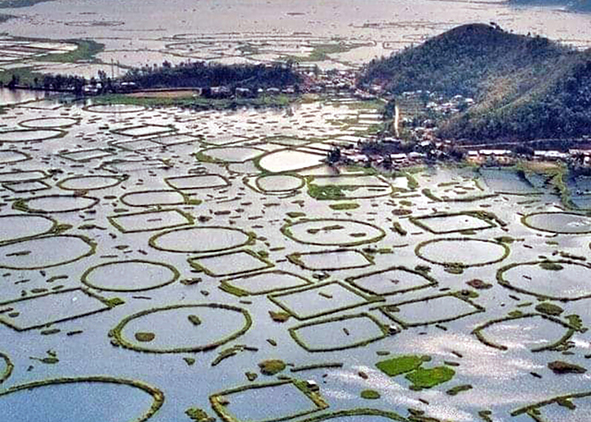
In an era marked by rapid advances in energy, climate, and global inequality, Loktak Lake in the State of Manipur (India) exemplifies the delicate balance between water governance and energy systems, as well as between local productive and dwelling practices. This study explores how adapting traditional practices in water landscapes can guide design configurations of sustainable amphibious ecosystems, proposing the ‘Loktak model’ as a post-growth paradigm. The Lake’s ecological uniqueness stems from its floating biomass islands and a seasonal economy rooted in fishing and agriculture. Despite the construction of imposed infrastructures such as the Ithai Dam – which disrupted natural regimes and caused environmental harm – local communities have responded with adaptive measures, notably in regenerating the floating islands known as Athapum Phumdi. Through multi-scalar mappings and socio-spatial analyses, the Lake is revealed as a hydro-cultural landscape where ‘floating circularity’ orchestrates hybrid infrastructures, water, energy, and labour. In this light, Loktak serves as a natural regulatory mechanism capable of inspiring projects in other amphibious settings and of guiding, in an unprecedented manner, a new approach within territorial studies.
Article info
Received: 20/09/2025; Revised: 23/10/2025; Accepted: 25/10/2025
Downloads
Article Metrics Graph
References
Ahern, J. (2013), “Urban landscape sustainability and resilience – The promise and challenges of integrating ecology with urban planning and design”, in Landscape Ecology, vol. 28, issue 6, pp. 1203-1212. [Online] Available at: doi.org/10.1007/s10980-012-9799-z [Accessed 20 September 2025].
Alami, I., Copley, J. and Moraitis, A. (2024), “The wicked trinity of late capitalism – Governing in an era of stagnation, surplus humanity, and environmental breakdown”, in Geoforum, vol. 153, article 103691, pp. 1-13. [Online] Available at: doi.org/10.1016/j.geoforum.2023.103691 [Accessed 20 September 2025].
Bensús Talavera, V. (2024), “Lessons on urban planning post-growth”, in Nature Cities, vol. 1, pp. 14-15. [Online] Available at: doi.org/10.1038/s44284-023-00006-4 [Accessed 15 September 2025].
Brisotto, C., Carney, J., Macaione, I. and Raffa, A. (2023), “Cambiamenti climatici nei paesaggi di bonifica – Adattamento tra modulo e modularità | Climate change in reclamation landscapes – Adaptation between module and modularity”, in Agathón | International Journal of Architecture, Art and Design, vol. 14, pp. 62-73. [Online] Available at: doi.org/10.19229/2464-9309/1442023 [Accessed 18 September 2025].
Buck, B. H., Troell, M. F., Krause, G., Angel, D. L., Grote, B. and Chopin, T. (2018), “State of the Art and Challenges for Offshore Integrated Multi-Trophic Aquaculture (IMTA)”, in Frontiers in Marine Science, vol. 5, article 165, pp. 1-21. [Online] Available at: doi.org/10.3389/fmars.2018.00165 [Accessed 18 September 2025].
Burke, M., Hsiang, S. M. and Miguel, E. (2015), “Global non-linear effect of temperature on economic production”, in Nature, vol. 527, pp. 235-239. [Online] Available at: doi.org/10.1038/nature15725 [Accessed 18 September 2025].
Chopin, T., Robinson, S. M. C., Troell, M., Neori, A., Buschmann, A. H. and Fang, J. (2008), “Multitrophic Integration for Sustainable Marine Aquaculture”, in Jorgensen, S. E. and Fath, B. D. (eds), Encyclopedia of Ecology, Elsevier, Amsterdam, pp. 2463-2475. [Online] Available at: doi.org/10.1016/B978-008045405-4.00065-3 [Accessed 18 September 2025].
Costanza, R., de Groot, R., Braat, L., Kubiszewski, I., Fioramonti, L., Sutton, P., Farber, S. and Grasso, M. (2017), “Twenty years of ecosystem services – How far have we come and how far do we still need to go?”, in Ecosystem Services, vol. 28, part A, pp. 1-16. [Online] Available at: doi.org/10.1016/j.ecoser.2017.09.008 [Accessed 20 September 2025].
Council of Europe (2016), Council of Europe Landscape Convention, as amended by the 2016 Protocol. [Online] Available at: rm.coe.int/16807b6bc7 [Accessed 20 September 2025].
Dessì, A. (2023), “Camminare nel selvatico – Per una transizione verso un paesaggio coevolutivo | Walking into the wild – A transition to a co-evolutionary landscape”, in Agathón | International Journal of Architecture, Art and Design, vol. 13, pp. 131-140. [Online] Available at: doi.org/10.19229/2464-9309/13112023 [Accessed 20 October 2025].
Devarani, L. and Basu, D. (2009), “Participatory wetland management in Loktak Lake – A road to sustainable development”, in Journal of Crop and Weed, vol. 5, issue 1, pp. 178-190. [Online] Available at: cropandweed.com/archives/2009/vol5issue1/37.pdf [Accessed 18 September 2025].
Devi, L. A. (2022), “The Study on Sociological Environment in Manipur”, in International Journal of Inclusive Development, vol. 8, issue 2, pp. 173-175. [Online] Available at: doi.org/10.30954/2454-4132.2.2022.9 [Accessed 18 September 2025].
Devi, R. S., Satapathy, K. B. and Kumar, S. (2024), “Loktak Lake of The State Manipur – A Review to Educate the Intellectuals and Awareness on Its Bio Wealth”, in Educational Administration – Theory and Practice, vol. 30, issue 5, pp. 6936-6947. [Online] Available at: doi.org/10.53555/kuey.v30i5.4064 [Accessed 20 October 2025].
Devi, R. S., Satapathy, K. B. and Kumar, S. (2022), “Ethnobotanical Plants of Phumdi, Loktak Lake, Manipur, India”, in Asian Pacific Journal of Health Sciences, vol. 9, issue 4, pp. 77-80. [Online] Available at: doi.org/10.21276/apjhs.2022.9.4.16 [Accessed 20 October 2025].
Durrant, D., Lamker, C. and Rydin, Y. (2023), “The Potential of Post-Growth Planning – Re-Tooling the Planning Profession for Moving beyond Growth”, in Planning Theory & Practice, vol. 24, issue 2, pp. 287-295. [Online] Available at: doi.org/10.1080/14649357.2023.2198876 [Accessed 18 September 2025].
Fioramonti, L. (2024), “Post-growth theories in a global world – A comparative analysis”, in Review of International Studies, vol. 50, issue 5, pp. 866-876. [Online] Available at: doi.org/10.1017/S0260210524000214 [Accessed 20 October 2025].
Ingaramo, R., Negrello, M., Khachatourian Saradehi, l. and Khachatourian Saradhi, A. (2023), “Il progetto transcalare delle nature-based solutions per l’Agenda 2030 – Innovazioni e interconnessioni | Transcalar project of nature-based solutions for the 2030 Agenda – Innovations and interconnections”, in Agathón | International Journal of Architecture, Art and Design, vol. 13, pp. 97-108. [Online] Available at: doi.org/10.19229/2464-9309/1382023 [Accessed 20 October 2025].
IPCC – Intergovernmental Panel on Climate Change (2023), Climate Change 2023 – Synthesis Report – Contribution of Working Groups I, II and III to the Sixth Assessment Report of the Intergovernmental Panel on Climate Change, IPCC, Geneva. [Online] Available at: doi.org/10.59327/IPCC/AR6-9789291691647 [Accessed 18 September 2025].
Irom, L. M., Ngasepam, P. S., Panmei, R. L. and Soiremi, V. S. (2025), “Ithai Barrage and Environmental Sustainability – A Case Study of Loktak Lake”, in International Journal of Ecology and Environmental Sciences, vol. 51, issue 2, pp. 181-190. [Online] Available at: doi.org/10.55863/ijees.2025.0609 [Accessed 11 September 2025].
Jackson, T. (2021), Post Growth – Life after Capitalism, Polity, Cambridge (UK).
Kallis, G., Hickel, J., O’Neill, D. W., Jackson, T., Victor, P. A., Raworth, K., Schor, J. B., Steinberger, J. K. and Ürge-Vorsatz, D. (2025), “Post-growth – The science of wellbeing within planetary boundaries”, in Lancet Planetary Health, vol. 9, issue 1, pp. e62-e78. [Online] Available at: doi.org/10.1016/S2542-5196(24)00310-3 [Accessed 10 September 2025].
Khoiyangbam, R. S. (2021), “Wetlands in Loktak – Issues and challenges of merging Wildlife conservation and Hydropower generation”, in International Journal of Lakes and Rivers, vol. 14, issue 2, pp. 223-236. [Online] Available at: ripublication.com/ijlr21/ijlrv14n2_07.pdf [Accessed 10 September 2025].
Koolhaas, R. (2020), Countryside – A Report, Taschen, Köln.
Kumar, S. (2024), “Navigating Sustainability in Loktak Lake – Socio-ecological changes and its impact on Wetland Ecosystem and Native Fishers”, in Journal of North East India Studies, vol. 14, issue 1, pp. 27-44. [Online] Available at: jneis.com/wp-content/uploads/2024/12/14.1.3.pdf [Accessed 10 September 2025].
Laishram, J. (2021), “A Study on the Bioresources of the Loktak Lake, Manipur (India) for Livelihood by the People Living in Five Villages Located in and Around the Lake”, in Current World Environment | An International Research Journal of Environmental Science, vol. 16, issue 3, pp. 928-941. [Online] Available at: dx.doi.org/10.12944/CWE.16.3.23 [Accessed 24 September 2025].
McNeill, J. R. and Engelke, P. (2016), The Great Acceleration – An Environmental History of the Anthropocene since 1945, The Belknap Press of Harvard University Press, Cambridge.
Meadows, D. H., Meadows, D. L., Randers, J. and Behrens, W. W. (1972), The Limits to Growth – A Report for the Club of Rome’s Project on the Predicament of Mankind, Universe Books, New York.
Meitei, M. D. and Prasad, M. N. V. (2015), “Phoomdi – A unique plant biosystem of Loktak Lake – Traditional and ecological knowledge”, in Plant Biosystems | An International Journal Dealing with all Aspects of Plant Biology, vol. 149, issue 4, pp. 777-787. [Online] Available at: doi.org/10.1080/11263504.2013.870250 [Accessed 24 September 2025].
Morpurgo, E. (2024), “Biomateriali e zone umide – Filiere per l’edilizia e il tessile dalla valorizzazione di ecosistemi locali | Biomaterials and wetlands – Supply chains for construction and textiles through the enhancement of local ecosystems”, in Agathón | International Journal of Architecture, Art and Design, vol. 16, pp. 314-323. [Online] Available at: doi.org/10.19229/2464-9309/16262024 [Accessed 20 September 2025].
Musacchio, L. R. (2009), “The scientific basis for the design of landscape sustainability – A conceptual framework for translational landscape research and practice of designed landscapes and the six Es of landscape sustainability”, in Landscape Ecology, vol. 24, issue 8, pp. 993-1013. [Online] Available at: doi.org/10.1007/s10980-009-9396-y [Accessed 20 September 2025].
Paonam, J. and Chatterjee, S. (2023), “Evaluating the Land Use Land Cover Dynamics of Loktak Lake – A Ramsar Wetland of International Importance in North East India”, in International Journal of Ecology and Environmental Sciences, vol. 49, issue 5, pp. 459-470. [Online] Available at: researchgate.net/publication/371491286_Evaluating_the_Land_Use_Land _Cover_Dynamics_of_Loktak_Lake_A_Ramsar_Wetland_of_International_ Importance_in_North_East_India [Accessed 24 September 2025].
Richardson, K., Steffen, W., Lucht, W., Cornell, S. E., Fetzer, I., Bennett, E. M., Donges, J. F., Gerten, D., Hoff, H., Lade, S. J., Rockström, J., Carpenter, S. R. and Folke, C. (2023), “Earth beyond six of nine planetary boundaries”, in Science Advances, vol. 9, issue 37, article eadh2458, pp. 1-16. [Online] Available at: doi.org/10.1126/sciadv.adh2458 [Accessed 20 October 2025].
Rizzi, C. (2025), “Osmosi, ibridazione, simbiosi – Dalla biofilia alla progettazione rigenerativa interspecifica | Osmosis, hybridisation, symbiosis – From biophilia to interspecies regenerative design”, in Agathón | International Journal of Architecture, Art and Design, vol. 17, pp. 146-155. [Online] Available at: doi.org/10.69143/2464-9309/1792025 [Accessed 20 October 2025].
Shannon, K., De Meulder, B. E. J., d’Auria, V. and Gosseye, J. (eds) (2008), Water Urbanisms, SUN, Amsterdam.
Singh, C. R., Thompson, J. R., Kingston, D. G. and French, J. R. (2011), “Modelling water-level options for ecosystem services and assessment of climate change – Loktak Lake, northeast India | Modélisation des choix de niveau d’eau pour les services écosystémiques et l’évaluation du changement climatique – lac Loktak, Inde du nord”, in Hydrological Sciences Journal, vol. 56, issue 8, pp. 1518-1542. [Online] Available at: doi.org/10.1080/02626667.2011.631012 [Accessed 20 October 2025].
Singh, K. D., Yi, X., Shagolsem, L. S. and Toijam, J. (2024), “Assessing Green Features of Phumdi as a Sustainable Material – A comparative analysis with bamboo, wood, metal, and plastic”, in Sustainability, vol. 16, issue 2, article 637, pp. 1-17. [Online] Available at: doi.org/10.3390/su16020637 [Accessed 20 October 2025].
Singh, K. J. (2017), “The Loktak Hydro Electricity Power Project in Manipur and its Impact on the Socio-Economic Conditions to the Catchment Areas”, in IOSR | Journal of Humanities and Social Science, vol. 22, issue 11, pp. 11-17. [Online] Available at: researchgate.net/publication/366657537_Wetlands_in_Loktak_Issues_and _challenges_of_merging_Wildlife_conservation_and_Hydropower_generation_-_An_Overview [Accessed 20 October 2025].
Singh, M. R. and Singh, K. T. (2023), “Environmental and socio-economic impacts of hydro power project – A case study of the Loktak hydroelectric project in Manipur”, in EPRA | International Journal of Socio-Economic and Environmental Outlook, vol. 10, issue 7, pp. 1-6. [Online] Available at: doi.org/10.36713/epra13794 [Accessed 20 October 2025].
Singh, W. R. and Kalamdhad, A. S. (2014), “Potential for composting of green phumdi biomass in Loktak Lake”, in Ecological Engineering, vol. 67, pp. 119-126. [Online] Available at: doi.org/10.1016/j.ecoleng.2014.03.086 [Accessed 20 October 2025].
Soper, K. (2020), Post-Growth Living – For an Alternative Hedonism, Verso Books, London/New York.
Spanier, J. and Feola, G. (2022), “Nurturing the post-growth city – Bringing the rural back in”, in Savini F., Ferreira, A. and von Schönfeld, K. C. (eds), Post-Growth Planning – Cities Beyond the Market Economy, Routledge, New York, pp. 159-172.
Steiner, F. (2011), “Landscape ecological urbanism – Origins and trajectories”, in Landscape and Urban Planning, vol. 100, issue 4, pp. 333-337. [Online] Available at: doi.org/10.1016/j.landurbplan.2011.01.020 [Accessed 20 October 2025].
UN – United Nations (2015), Transforming our World – The 2030 Agenda for Sustainable Development, document A/RES/70/1. [Online] Available at: sustainabledevelopment.un.org/index.php?page=viewandtype=111andnr=8496andmenu=35 [Accessed 20 October 2025].
Vacanti, A. and Lonardi, C. (2024), “Tecnologia, energia e tempo – Percorsi sperimentali per il design di tecnologie appropriate | Technology, energy, and time – Experimental paths for the design of appropriate technology”, in Agathón | International Journal of Architecture, Art and Design, vol. 15, pp. 316-323. [Online] Available at: doi.org/10.19229/2464-9309/15262024 [Accessed 20 October 2025].
Waldheim, C. (2016), Landscape as Urbanism – A General Theory, Princeton University Press, Princeton, New Jersey.
Watson, J. (2025), Lo-TEK – Water – A Field Guide for TEKnology, Taschen, Köln.
Weller, R. J., Hoch, C. and Huang, C. (2017), Atlas for the End of the World. [Online] Available at: atlas-for-the-end-of-the-world.com [Accessed 20 October 2025].
Zhang, J., Zhang, S., Kitazawa, D., Zhou, J., Park, S., Gao, S. and Shen, Y. (2019), “Bio-mitigation based on integrated multi-trophic aquaculture in temperate coastal waters – Practice, assessment, and challenges”, in Latin American Journal of Aquatic Research, vol. 47, issue 2, pp. 212-223. [Online] Available at: lajar.cl/index.php/rlajar/article/view/vol47-issue2-fulltext-1/1043 [Accessed 20 October 2025].
Downloads
Published
How to Cite
Issue
Section
Categories
License
Copyright (c) 2025 Matteo D’Ambros, Stefano Tornieri

This work is licensed under a Creative Commons Attribution 4.0 International License.
This Journal is published under Creative Commons Attribution Licence 4.0 (CC-BY).
License scheme | Legal code
This License allows anyone to:
Share: copy and redistribute the material in any medium or format.
Adapt: remix, transform, and build upon the material for any purpose, even commercially.
Under the following terms
Attribution: Users must give appropriate credit, provide a link to the license, and indicate if changes were made; users may do so in any reasonable manner, but not in any way that suggests the licensor endorses them or their use.
No additional restrictions: Users may not apply legal terms or technological measures that legally restrict others from doing anything the license permits.
Notices
Users do not have to comply with the license for elements of the material in the public domain or where your use is permitted by an applicable exception or limitation.
No warranties are given. The license may not give users all of the permissions necessary for their intended use. For example, other rights such as publicity, privacy, or moral rights may limit how you use the material.