Climate shelters as adaptive urban infrastructures – A systemic network to reduce inequalities
DOI:
https://doi.org/10.69143/2464-9309/19102026Keywords:
climate shelters, climate justice, green infrastructures, urban climate vulnerability, spatial equityAbstract
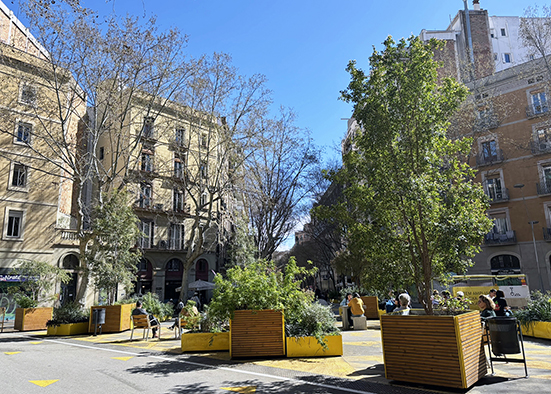
Climate change is intensifying inequalities in urban areas, affecting vulnerable populations more severely during extreme heatwaves. In this context, this article proposes a critical reinterpretation of climate shelters as permanent urban infrastructures of redistribution explicitly linked to SDG 10 (Reduce inequalities). Through a structured critical literature review, a comparative analysis of pioneering international case studies (Barcelona, Paris, Bilbao), and the experimentation conducted in Bologna within the PNRR Ecosister and TALEA projects, the research demonstrates how interconnected networks of climate shelters, conceived as relational and systemic devices integrating nature-based solutions, digital innovation, and social inclusion, can counter spatial and climate injustices, guaranteeing the right to comfort as a shared environmental right.
Article info
Received: 10/03/2026; Revised: 15/04/2026; Accepted: 17/04/2026
Downloads
Article Metrics Graph
References
Amorim-Maia, A., Anguelovski, I., Connolly, J. and Chu, E. (2023), “Seeking refuge? – The potential of urban climate shelters to address intersecting vulnerabilities”, in Landscape and Urban Planning, vol. 238, article 104836, pp. 1-12. [Online] Available at: doi.org/10.1016/j.landurbplan.2023.104836 [Accessed 28 March 2026].
Anguelovski, I. (2014), Neighborhood as Refuge – Community Reconstruction, Place Remaking, and Environmental Justice in the City, MIT Press, Cambridge. [Online] Available at: doi.org/10.7551/mitpress/9780262026925.001.0001 [Accessed 28 March 2026].
Armondi, S., Balducci, A., Bovo, M. and Galimberti, B. (eds) (2022), Cities learning from pandemic – Towards preparedness, Routledge, London. [Online] Available at: doi.org/10.4324/9781003240983 [Accessed 28 March 2026].
Baró, F., Camacho, D. A., Pérez del Pulgar, C., Ruiz-Mallén, I. and García-Serrano, P. (2022), “Nature-Based Climate Solutions in European Schools – A pioneering Co-designed Strategy Towards Urban Resilience”, in Ruiz-Mallén, I., March, H. and Satorras, M. (eds), Urban Resilience to the Climate Emergency – Unravelling the transformative potential of institutional and grassroots initiatives, Springer, Cham, pp. 125-146. [Online] Available at: doi.org/10.1007/978-3-031-07301-4_6 [Accessed 28 March 2026].
Beretta, I. and Cucca, R. (2019), “Ecological gentrification – A European perspective – Introduction”, in Sociologia Urbana e Rurale, vol. 119, pp. 7-10. [Online] Available at: doi.org/10.3280/SUR2019-119001 [Accessed 28 March 2026].
Berretta, T., Desideri, F. and Staltari, M. (2024), “Il progetto dello spazio pubblico, tra complessità e crisi ecologica – Da sfida a opportunità per la rigenerazione urbana | Public space project, between complexity and ecological crisis – From challenge to opportunity for urban regeneration”, in Agathón | International Journal of Architecture, Art and Design, vol. 16, pp. 74-87. [Online] Available at: doi.org/10.19229/2464-9309/1662024 [Accessed 28 March 2026].
Bressane, A., da Cunha Pinto, J. P. and de Castro Medeiros, L. C. (2024), “Countering the effects of urban green gentrification through nature-based solutions – A scoping review”, in Nature-Based Solutions, vol. 5, article 100131, pp. 1-7. [Online] Available at: doi.org/10.1016/j.nbsj.2024.100131 [Accessed 28 March 2026].
Bulkeley, H, Carmin, J., Broto, V. C., Edwards, G. A. S. and Fuller, S. (2013), “Climate justice and global cities – Mapping the emerging discourses”, in Global Environmental Change, vol. 23, issue 5, pp. 914-925. [Online] Available at: doi.org/10.1016/j.gloenvcha.2013.05.010 [Accessed 28 March 2026].
Campagnaro, C., Ronsivalle, D., Di Prima, N., Curtabbi, G. and Passaro, R. (2025), “Fare e rifare – Opportunità e limiti della co-progettazione per gli spazi pubblici e di welfare | Doing and redoing – Opportunities and limits of co-design for public and welfare spaces”, in Agathón | International Journal of Architecture, Art and Design, vol. 17, pp. 310-323. [Online] Available at: doi.org/10.69143/2464-9309/17212025 [Accessed 28 March 2026].
Carta, M. (2025), Sette lezioni di rigenerazione urbana, LetteraVentidue, Siracusa.
Chaza Chimeno, M. R., Revellini, R. and Cellucci, C. (2024), “Invecchiamento della popolazione e spazi urbani – Nuove sfide digitali per il benessere degli anziani | Ageing population and urban spaces – New digital challenges for elderly well-being”, in Agathón | International Journal of Architecture, Art and Design, vol. 16, pp. 98-107. [Online] Available at: doi.org/10.19229/2464-9309/1682024 [Accessed 28 March 2026].
Fiorini, L., Saganeiti, L., Perazzini, M., Bontempo, D., Bucci, M., Giancola, M. and Perilli, E. (2025), “L’impatto dei modelli urbani sul supporto sociale – Tra giustizia spaziale e sviluppo sostenibile | The impact of urban models on social support – Between spatial justice and sustainable development”, in Agathón | International Journal of Architecture, Art and Design, vol. 17, pp. 196-207. [Online] Available at: doi.org/10.69143/2464-9309/17132025 [Accessed 28 March 2026].
Haraway, D. J. (2016), Staying with the trouble – Making kin in the Chthulucene, Duke University Press, London. [Online] Available at: doi.org/10.1215/9780822373780 [Accessed 28 March 2026].
Harvey, D. (2008), “The right to the city”, in New Left Review, vol. 53, pp. 23-40. [Online] Available at: doi.org/10.64590/fmh [Accessed 28 March 2026].
IPCC (2023), Climate Change 2022 – Impacts, Adaptation and Vulnerability – Working Group II Contribution to the Sixth Assessment Report of the Intergovernmental Panel on Climate Change, Cambridge University Press, Cambridge. [Online] Available at: doi.org/10.1017/9781009325844 [Accessed 28 March 2026].
Konijnendijk, C. C. (2023), “Evidence-based guidelines for greener, healthier, more resilient neighbourhoods – Introducing the 3-30-300 rule”, in Journal of Forestry Research, vol. 34, issue 3, pp. 821-830. [Online] Available at: doi.org/10.1007/s11676-022-01523-z [Accessed 28 March 2026].
López Plazas, F., Crespo Sánchez, E., Llorca Pérez, R. and Santacana Albanilla, E. (2023), “Schools as climate shelters – Design, implementation and monitoring methodology based on the Barcelona experience”, in Journal of Cleaner Production, vol. 432, article 139588, pp. 1-20. [Online] Available at: doi.org/10.1016/j.jclepro.2023.139588 [Accessed 28 March 2026].
Macaluso, L. and Palma, A. (2025), “Foreste abitate – Architettura per la salute, il benessere e l’uguaglianza | Inhabited forests – Architecture for health, well-being, and equality”, in Agathón | International Journal of Architecture, Art and Design, vol. 17, pp. 180-195. [Online] Available at: doi.org/10.69143/2464-9309/17122025 [Accessed 28 March 2026].
Maccabiani, E., Usmani, M., Nanni, R. and Napolitano, M. (2025), “Investigating Social Vulnerability to Extreme Heat – Heat Islands and climate shelters – The Case of Bologna”, in ISPRS | International Journal of Geo-Information, vol. 14, issue 1, article 17, pp. 1-17. [Online] Available at: doi.org/10.3390/ijgi14010017 [Accessed 28 March 2026].
Magliocco, A. and Oneto, G. (2023), “Configurazioni spaziali nell’analisi ambientale urbana – Il contributo dell’isola di calore | Spatial configurations in urban environmental analysis – The role of the heat island effect”, in Agathón | International Journal of Architecture, Art and Design, vol. 14, pp. 216-223. [Online] Available at: doi.org/10.19229/2464-9309/14182023 [Accessed 28 March 2026].
Ministère de la Santé et de la protection sociale, Ministère délégué aux personnes agées and Ministère de l’intérieur, de la sécurité intérieure et des libertés locales (2004), Circulaire n° 2004-219 du 12 mai 2004 définissant les actions à mettre en oeuvre au niveau local pour détecter, prévenir et lutter contre les conséquences sanitaires d'une canicule. [Online] Available at: sante.gouv.fr/fichiers/bo/2004/04-44/a0442935.htm [Accessed 28 March 2026].
Mitchell, D. (2003), The Right to the City – Social Justice and the Fight for Public Space, Guilford Press, New York.
Nazish, A., Abbas, K. and Sattar, E. (2024), “Health Impact of Urban Green Spaces – A Systematic Review of Heat-Related Morbidity and Mortality”, in BMJ Open, vol. 14, article e081632, pp. 1-8. [Online] Available at: doi.org/10.1136/bmjopen-2023-081632 [Accessed 28 March 2026]
Nixon, R. (2011), Slow Violence and the Environmentalism of the Poor, Harvard University Press, Cambridge (MA). [Online] Available at: doi.org/10.2307/j.ctt2jbsgw [Accessed 28 March 2026]
Pede, E. C. (2024), “Heat waves and urban vulnerability – Climate shelters, public services and innovative solutions – Lessons from Barcelona”, in Urban Research & Practice, vol. 17, issue 3, pp. 465-471. [Online] Available at: doi.org/10.1080/17535069.2024.2329058 [Accessed 28 March 2026].
Pollo, R., Biolchini, E. and Scognamiglio, V. (2023), “Progettare le Case della Comunità – Applicazione dell’approccio modulare a un modello innovativo di presidio | Designing Community Houses – Application of the modular approach to an innovative model of facility”, in Agathón | International Journal of Architecture, Art and Design, vol. 14, pp. 224-235. [Online] Available at: doi.org/10.19229/2464-9309/14192023 [Accessed 28 March 2026].
Roversi, R. and Longo, D. (2025), “Regenerative and connective green Cells to address fragmentation and climate change in cities – The TALEA project integrated solution”, in Sustainability, vol. 17, issue 7, article 3175, pp. 1-25. [Online] Available at: doi.org/10.3390/su17073175 [Accessed 28 March 2026].
Sanz-Mas, M., Continente, X., Marí-Dell’Olmo, M. and López, M. J. (2025), “Community Use and Perceptions of Climate Shelters in Schoolyards in Barcelona”, in International Journal of Public Health, vol. 70, article 1608083, pp. 1-10. [Online] Available at: doi.org/10.3389/ijph.2025.1608083 [Accessed 28 March 2026].
Secchi, B. (2013), La città dei ricchi e la città dei poveri, Laterza, Milano.
Setola, N. and Borgianni, S. (2025), “Promuovere salute e benessere – Strumenti per il progetto di Case della Comunità e quartieri sani | Promoting health and well-being – Tools for designing community health centres and healthy neighbourhoods”, in Agathón | International Journal of Architecture, Art and Design, vol. 17, pp. 226-241. [Online] Available at: doi.org/10.69143/2464-9309/17152025 [Accessed 28 March 2026].
Soja, E. W. (2010), Seeking spatial justice, University of Minnesota Press, Minneapolis. [Online] Available at: doi.org/10.5749/minnesota/9780816666676.001.0001 [Accessed 28 March 2026].
Sposito, C. and Mittersteiner, G. (2025), “Riciclo idrico e raffrescamento urbano – Un nuovo paradigma metabolico Acqua / Energia / Cibo per le città temperate | Water recycling and urban cooling – A new Water / Energy / Food metabolic paradigm for temperate cities”, in Agathón | International Journal of Architecture, Art and Design, vol. 18, pp. 22-71. [Online] Available at: doi.org/10.69143/2464-9309/1812025 [Accessed 28 March 2026].
Tucci, F., Altamura, P. and Pani, M. M. (2023), “Modulare le dinamiche urbane in chiave climatica – Spazi intermedi e neutralità climatica | Modulating urban dynamics from a climate perspective – In-between spaces and climate neutrality”, in Agathón | International Journal of Architecture, Art and Design, vol. 14, pp. 204-215. [Online] Available at: doi.org/10.19229/2464-9309/14172023 [Accessed 28 March 2026].
Tzortzi, J. N., Lux, M. S. and Pardo Delgado, N. (2024), “Infrastrutture verdi urbane in America Latina – Una strategia per i cortili di Bogotà | Urban Green Infrastructure in Latin America – A strategy for Bogota courtyards”, in Agathón | International Journal of Architecture, Art and Design, vol. 15, pp. 216-227. [Online] Available at: doi.org/10.19229/2464-9309/15172024 [Accessed 28 March 2026].
UN – United Nations (2015), Transforming Our World – The 2030 Agenda for Sustainable Development. [Online] Available at: sdgs.un.org/2030agenda [Accessed 28 March 2026].
Valente, R., Mozingo, L. A., Bosco, R. and Giacobbe, S. (2024), “Gestione integrata delle risorse naturali in contesti urbani sostenibili | Integrated natural resource management in sustainable urban context”, in Agathón | International Journal of Architecture, Art and Design, vol. 15, pp. 180-189. [Online] Available at: doi.org/10.19229/2464-9309/15142024 [Accessed 28 March 2026].
World Health Organization Regional Office for Europe (2008), Heat-Health Action Plans – Guidance, World Health Organization Regional Office for Europe, Copenhagen. [Online] Available at: who.int/europe/publications/i/item/9789289071918 [Accessed 28 March 2026].
Zarcone, R., Nava, F. and Tucci, F. (2024), “Mitigazione del clima e comfort umano – Uno strumento per la modellazione e simulazione di supporto alle decisioni | Climate mitigation and human comfort – A decision-support modeling and simulation tool”, in Agathón | International Journal of Architecture, Art and Design, vol. 15, pp. 228-237. [Online] Available at: doi.org/10.19229/2464-9309/15182024 [Accessed 28 March 2026].
Downloads
Published
How to Cite
Issue
Section
Categories
License
Copyright (c) 2026 Danila Longo, Rossella Roversi, Riccardo Mercuri, Beatrice Turillazzi

This work is licensed under a Creative Commons Attribution 4.0 International License.
This Journal is published under Creative Commons Attribution Licence 4.0 (CC-BY).
License scheme | Legal code
This License allows anyone to:
Share: copy and redistribute the material in any medium or format.
Adapt: remix, transform, and build upon the material for any purpose, even commercially.
Under the following terms
Attribution: Users must give appropriate credit, provide a link to the license, and indicate if changes were made; users may do so in any reasonable manner, but not in any way that suggests the licensor endorses them or their use.
No additional restrictions: Users may not apply legal terms or technological measures that legally restrict others from doing anything the license permits.
Notices
Users do not have to comply with the license for elements of the material in the public domain or where your use is permitted by an applicable exception or limitation.
No warranties are given. The license may not give users all of the permissions necessary for their intended use. For example, other rights such as publicity, privacy, or moral rights may limit how you use the material.