Biciclette e cargo bike – Modelli ibridi modulari per micromobilità urbana e logistica
DOI:
https://doi.org/10.69143/2464-9309/19272026Parole chiave:
micromobilità urbana, veicoli leggeri modulari, cargo bike, logistica di ultimo miglio, mobilità ibridaAbstract
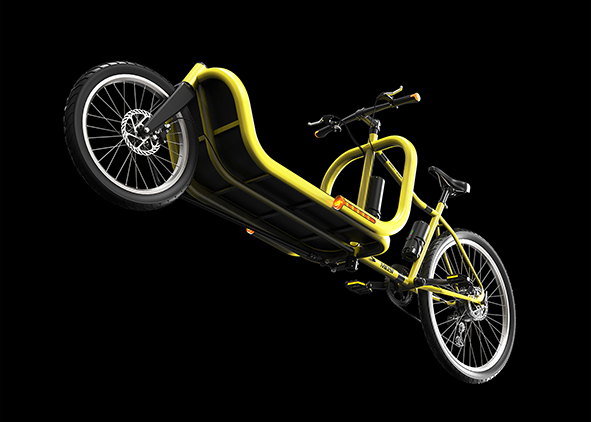
Il contributo esplora la modularità come leva progettuale per integrare micromobilità personale e logistica. Assumendo come caso studio di partenza un veicolo leggero modulare sviluppato nell’ambito del Centro Nazionale per la Mobilità Sostenibile (Spoke 5 ‘Light Vehicle and Active Mobility’) la ricerca adotta un approccio Design Thinking e un modello Double Diamond, combinando l’analisi della letteratura, il confronto con esperti, l’uso di fattori ricorrenti e lo sviluppo di scenari. Ne risultano un framework interpretativo fondato su cinque fattori chiave dei sistemi di micromobilità urbana e la proposta di un modello di Hybrid Professional Micromobility, in cui la riconfigurabilità del veicolo abilita usi ibridi tra spostamenti quotidiani e servizi di prossimità. I risultati evidenziano implicazioni rilevanti su flessibilità d’uso, gestione della flotta e riconfigurazione dei servizi.
Info sull'articolo
Ricevuto: 10/03/2026; Revisionato: 16/04/2026; Accettato: 22/04/2026
Downloads
##plugins.generic.articleMetricsGraph.articlePageHeading##
Riferimenti bibliografici
Abduljabbar, R. L., Liyanage, S. and Dia, H. (2021), “The role of micro-mobility in shaping sustainable cities – A systematic literature review”, in Transportation Research part D | Transport and Environment, vol. 92, article 102734, pp. 1-19. [Online] Available at: doi.org/10.1016/j.trd.2021.102734 [Accessed 7 April 2026].
Allen, J., Piecyk, M., Piotrowska, M., McLeod, F., Cherrett, T., Ghali, K., Nguyen, T., Bektas, T., Bates, O., Friday, A., Wise, S. and Austwick, M. (2018), “Understanding the impact of e-commerce on last-mile light goods vehicle activity in urban areas – The case of London”, in Transportation Research Part D | Transport and Environment, vol. 61, part B, pp. 325-338. [Online] Available at: doi.org/10.1016/j.trd.2017.07.020 [Accessed 7 April 2026].
Archer, B. (1995), “The nature of research”, in Co-Design Journal, vol. 2, issue 11, pp. 6-13. [Online] Available at: ia801302.us.archive.org/4/items/ TheNatureOfResearch/Archer1995Codesign.pdf [Accessed 7 April 2026].
Arias-Molinares, D., Xu, Y., Büttner, B. and Duran-Rodas, D. (2023), “Exploring key spatial determinants for mobility hub placement based on micromobility ridership”, in Journal of Transport Geography, vol. 110, article 103621, pp. 1-14. [Online] Available at: doi.org/10.1016/j.jtrangeo.2023.103621 [Accessed 7 April 2026].
Bachofner, M., Lemardelé, C., Estrada, M. and Pagès, L. (2022), “City logistics – Challenges and opportunities for technology providers”, in Journal of Urban Mobility, vol. 2, article 100020, pp. 1-10. [Online] Available at: doi.org/10.1016/j.urbmob.2022.100020 [Accessed 7 April 2026].
Baldwin, C. Y. and Clark, K. B. (1994), “Modularity-in-design – An analysis based on the theory of real options”, in Harvard Business School, pp. 1-44. [Online] Available at: academia.edu/download/44259940/Modularity-In-Design_An_Analysis_Based_O20160331-25099-aenprh.pdf [Accessed 7 April 2026].
Betancur Arenas, J., Lebeau, P. and Macharis, C. (2024), “From regular cyclist to cargo bike user? – A step closer to enhancing cargo bike culture”, in McNally, C., Carroll, P., Martinez-Pastor, B., Ghosh, B., Efthymiou, M. and Valantasis-Kanellos, N. (eds), Transport Transitions – Advancing Sustainable and Inclusive Mobility – Proceedings of the 10th TRA Conference – Volume 2, Dublin, Ireland, April 15-18, 2024, Springer, Cham, Lecture Notes in Mobility, pp. 134-139. [Online] Available at: doi.org/10.1007/978-3-031-85578-8_18 [Accessed 7 April 2026].
Bruno, D., Palmieri, S., Palomba, R., D’Alessandro, F. and Bisson, M. (2024), “Infrastrutture di mobilità intelligenti e sostenibili – Un nuovo sistema di connessioni urbane | Smart and sustainable mobility infrastructure – A new system of urban connections”, in Agathón | International Journal of Architecture, Art and Design, vol. 15, pp. 286-295. [Online] Available at: doi.org/10.19229/2464-9309/15232024 [Accessed 7 April 2026].
Buehler, R. and Pucher, J. (eds) (2021), Cycling for sustainable cities, MIT Press, Cambridge (MA).
Buldeo Rai, H., Verlinde, S., Merckx, J. and Macharis, C. (2017), “Crowd logistics – An opportunity for more sustainable urban freight transport?”, in European Transport Research Review, vol. 9, issue 3, article 39, pp. 1-13. [Online] Available at: doi.org/10.1007/s12544-017-0256-6 [Accessed 7 April 2026].
Canessa, N. V. and Centanaro, C. (2024), “Co(mplex)city – Utente come sensore urbano e mobilità accessibile nel progetto Mobiquity | Co(mplex)city – User as urban sensor and accessible mobility in the Mobiquity project”, in Agathón | International Journal of Architecture, Art and Design, vol. 16, pp. 88-97. [Online] Available at: doi.org/10.19229/2464-9309/1672024 [Accessed 7 April 2026].
Carracedo, D. and Mostofi, H. (2022), “Electric cargo bikes in urban areas – A new mobility option for private transportation”, in Transportation Research Interdisciplinary Perspectives, vol. 16, article 100705, pp. 1-11. [Online] Available at: doi.org/10.1016/j.trip.2022.100705 [Accessed 7 April 2026].
de Oliveira, C. M., Albergaria de Mello Bandeira, R., Vasconcelos Goes, G., Schmitz Gonçalves, D. N. and De Almeida D’Agosto, M. (2017), “Sustainable vehicles-based alternatives in last mile distribution of urban freight transport – A systematic literature review”, in Sustainability, vol. 9, issue 8, article 1324, pp. 1-15. [Online] Available at: doi.org/10.3390/su9081324 [Accessed 7 April 2026].
Eom, J. K., Lee, K. S. and Lee, J. (2023), “Exploring micromobility mode preferences for last-mile trips from subway stations”, in Journal of Public Transportation, vol. 25, article 100054, pp. 1-11. [Online] Available at: doi.org/10.1016/j.jpubtr.2023.100054 [Accessed 7 April 2026].
European Commission (2019), Communication from the Commission to the European Parliament, the European Council, the Council, the European Economic and Social Committee and the Committee of the Regions – The European Green Deal, document 52019DC0640, COM/2019/640 final. [Online] Available at: eur-lex.europa.eu/legal-content/EN/TXT/?uri=CELEX:52019DC0640 [Accessed 7 April 2026].
Fabbri, I. (2023), “Smart Hubs – Una rete di oggetti urbani multifunzionali a supporto della micromobilità a Ferrara | Smart Hubs – A network of multifunctional urban objects to support micromobility in Ferrara”, in Agathón | International Journal of Architecture, Art and Design, vol. 14, pp. 304-315. [Online] Available at: doi.org/10.19229/2464-9309/14262023 [Accessed 7 April 2026].
Galvin, P. and Morkel, A. (2001), “Modularity on industry structure – The case of the world – The effect of product bicycle industry”, in Industry and Innovation, vol. 8, issue 1, pp. 31-47. [Online] Available at: dx.doi.org/10.1080/13662710120034392 [Accessed 7 April 2026].
Gerring, J. (2006), Case Study Research – Principles and Practices, Cambridge University Press, Cambridge (MA).
Gunes, S., Fried, T. and Goodchild, A. (2024), “Seattle microhub delivery pilot – Evaluating emission impacts and stakeholder engagement”, in Case Studies on Transport Policy, vol. 15, article 101119, pp. 1-10. [Online] Available at: doi.org/10.1016/j.cstp.2023.101119 [Accessed 7 April 2026].
Jonas, W. (2015), “Research through design is more than just a new form of disseminating design outcomes”, in Constructivist Foundations, vol. 11, issue 1, pp. 32-36. [Online] Available at: constructivist.info/11/1/032.jonas [Accessed 7 April 2026].
Kania, M., Rolf, B., Assmann, T. and Zadek, H. (2022), “The smaller, the better? – Nano-hubs for cycle logistics as an urban-friendly alternative to micro-hubs”, in Logistics Journal | Proceedings, vol. 18, pp. 1-12. [Online] Available at: doi.org/10.2195/lj_proc_kania_en_202211_01 [Accessed 7 April 2026].
Katsela, K., Gunes, S., Fried, T., Goodchild, A. and Browne, M. (2022), “Defining urban freight microhubs – A case study analysis”, in Sustainability, vol. 14, issue 1, article 532, pp. 1-27. [Online] Available at: doi.org/10.3390/su14010532 [Accessed 7 April 2026].
Knapp, J., Zeratsky, J. and Kowitz, B. (2022), Sprint – Come risolvere grandi problemi e testare nuove idee in soli cinque giorni, Edizioni LSWR, Milano.
La Regina, R., Adinolfi, T., Pappalardo, C. M. and Guida, D. (2025), “Definition of the Functional Requirements for the Design of an Autonomous Light-Weight Pedal Assisted Urban Vehicle”, in Karabegović, I., Kovačević, A. and Mandžuka, S. (eds), New Technologies, Development and Applications – Proceedings of the 11th International Conference New Technologies and Applications, Sarajevo, Bosnia and Herzegovina, June 26-28, 2025, Lecture Notes in Networks and Systems, vol. 1482, Springer, Cham, pp. 474-485. [Online] Available at: doi.org/10.1007/978-3-031-95194-7_49 [Accessed 7 April 2026].
Luo, Q., Li, S. and Hampshire, R. C. (2021), “Optimal design of intermodal mobility networks under uncertainty – Connecting micromobility with mobility-on-demand transit”, in EURO Journal on Transportation and Logistics, vol. 10, article 100045, pp. 1-14. [Online] Available at: doi.org/10.1016/j.ejtl.2021.100045 [Accessed 7 April 2026].
Mangiaracina, R., Perego, A., Seghezzi, A. and Tumino, A. (2019), “Innovative solutions to increase last-mile delivery efficiency in B2C e-commerce – A literature review”, in International Journal of Physical Distribution & Logistics Management, vol. 49, issue 9, pp. 901-920. [Online] Available at: doi.org/10.1108/IJPDLM-02-2019-0048 [Accessed 7 April 2026].
Marincek, D., Rérat, P. and Lurkin, V. (2024), “Cargo bikes for personal transport – A user segmentation based on motivations for use”, in International Journal of Sustainable Transportation, vol. 18, issue 9, pp. 751-764. [Online] Available at: doi.org/10.1080/15568318.2024.2402753 [Accessed 7 April 2026].
Martens, K. (2007), “Promoting bike-and-ride – The Dutch experience”, in Transportation Research Part A | Policy and Practice, vol. 41, issue 4, pp. 326-338. [Online] Available at: doi.org/10.1016/j.tra.2006.09.010 [Accessed 7 April 2026].
Oeschger, G., Caulfield, B., and Carroll, P. (2025), “User characteristics and preferences for micromobility use in first-and last-mile journeys in Dublin, Ireland”, in Travel Behaviour and Society, vol. 38, article 100926, pp. 1-13. [Online] Available at: doi.org/10.1016/j.tbs.2024.100926 [Accessed 7 April 2026].
Oliveira, L. K., Oliveira, I. K., Leite Nascimento, C. de O., Marcucci, E. and Gatta, V. (2025), “Mobility as a service for freight and passenger transport – Identifying a microhubs network to promote crowdshipping service”, in Case Studies on Transport Policy, vol. 19, article 101356, pp. 1-12. [Online] Available at: doi.org/10.1016/j.cstp.2024.101356 [Accessed 16 April 2026].
Pietroni, L., Di Stefano, A. and Galloppo, D. (2023), “Il design modulare verso l’economia circolare – Dal ‘fare per disfare’ al ‘fare per rifare’ | Modular design towards the circular economy – From ‘making to unmake’ to ‘making to remake’”, in Agathón | International Journal of Architecture, Art and Design, vol. 14, pp. 274-283. [Online] Available at: doi.org/10.19229/2464-9309/14232023 [Accessed 7 April 2026].
Pucher, J. and Buehler, R. (eds) (2012), City cycling, MIT Press, Cambridge (MA).
Rinaldi, A. and Lagrimino, J. (2026), “Modular and Adaptive Approach for Advancing Innovation and Sustainability in Light Vehicles Design”, in Applied Sciences, vol. 16, issue 3, article 1151, pp. 1-34. [Online] Available at: doi.org/10.3390/app16031151 [Accessed 7 April 2026].
Rinaldi, A., Busciantella-Ricci, D. and Viviani, S. (2024), “Design for Movability – A New Design Research Challenge for Sustainable Design Scenarios in Urban Mobility”, in For Nature / With Nature – New sustainable design scenarios, Springer, Cham, Springer Series in Design and Innovation, vol. 38, pp. 929-949. [Online] Available at: doi.org/10.1007/978-3-031-53122-4_55 [Accessed 16 April 2026].
Schomakers, E. M., Klatte, M., Lotz, V., Biermann, H., Kober, F. and Ziefle, M. (2022), “Analysis of the potential of a new concept for urban last-mile delivery – Ducktrain”, in Transportation Research Interdisciplinary Perspectives, vol. 14, article 100579, pp. 1-10. [Online] Available at: doi.org/10.1016/j.trip.2022.100579 [Accessed 7 April 2026].
Shafiee, A., Moghaddam, H. R., Ballare, S. and Lin, J. (2026), “An alternative last-mile delivery system – Leveraging microhubs and crowdshipping”, in Transportation Research Part D | Transport and Environment, vol. 154, article 105239, pp. 1-28. [Online] Available at: doi.org/10.1016/j.trd.2026.105239 [Accessed 7 April 2026].
Simoni, M. D., Marcucci, E., Gatta, V. and Claudel, C. G. (2020), “Potential last-mile impacts of crowdshipping services – A simulation-based evaluation”, in Transportation, vol. 47, issue 4, pp. 1933-1954. [Online] Available at: doi.org/10.1007/s11116-019-10028-4 [Accessed 7 April 2026].
Sommariva, E. and Canessa, N. (2024), “Bicycle Infrascapes – La mobilità ciclabile come occasione di rigenerazione urbana e progetto dello spazio pubblico”, in Bricocoli, M. and Pezzagno, M. (eds), Atti della XXV Conferenza Nazionale SIU ‘Transizioni, giustizia spaziale e progetto di territorio’, Cagliari, Italy, June 15-16, 2023, Planum, Roma, pp. 303-312. [Online] Available at: hdl.handle.net/11567/1190036 [Accessed 7 April 2026].
Stokkink, P. and Geroliminis, N. (2025), "On the optimal micro-hub locations in a multimodal last-mile delivery system", in Transportation Research Part E | Logistics and Transportation Review, vol. 203, article 104344, pp. 1-15. [Online] Available at: doi.org/10.1016/j.tre.2025.104344 [Accessed 7 April 2026].
Tamborrini, P. and Cretaio, S. (2023), “Relazioni modulari negli spazi di lavoro – Approcci data-driven per progettarne il futuro | Modular relations in work environments – Data-driven approaches to design their future”, in Agathón | International Journal of Architecture, Art and Design, vol. 14, pp. 284-293. [Online] Available at: doi.org/10.19229/2464-9309/14242023 [Accessed 16 April 2026].
Tosi, F., Belli, A., Rinaldi, A. and Tucci, G. (2012), "The Intermodal Bike: multimodal integration of cycling mobility through product and process innovations in bicycle design", in Work | A Journal of Prevention, Assessment & Rehabilitation, vol. 41, issue S1, pp. 1501-1506. [Online] Available at: doi.org/10.3233/WOR-2012-0344-1501 [Accessed 16 April 2026].
Van Cauwenberg, J., De Bourdeaudhuij, I., Clarys, P., De Geus, B. and Deforche, B. (2019), “E-bikes among older adults – Benefits, disadvantages, usage and crash characteristics”, in Transportation, vol. 46, issue 6, pp. 2151-2172. [Online] Available at: doi.org/10.1007/s11116-018-9919-y [Accessed 7 April 2026].
Viviani, S., Gulino, M.-S., Rinaldi, A., and Vangi, D. (2024), “An interdisciplinary double-diamond design thinking model for urban transport product innovation – A design framework for innovation combining mixed methods for developing the electric microvehicle Leonardo Project”, in Energies, vol. 17, issue 23, article 5918, pp. 1-23. [Online] Available at: doi.org/10.3390/en17235918 [Accessed 7 April 2026].
Zhang, Y., Kasraian, D. and van Wesemael, P. (2023), “Built environment and micro-mobility – A systematic review of international literature”, in Journal of Transport and Land Use, vol. 16, issue 1, pp. 293-317. [Online] Available at: jstor.org/stable/48758162 [Accessed 7 April 2026].
##submission.downloads##
Pubblicato
Come citare
Fascicolo
Sezione
Categorie
Licenza
Copyright (c) 2026 Alessandra Rinaldi, Jonathan Lagrimino

TQuesto lavoro è fornito con la licenza Creative Commons Attribuzione 4.0 Internazionale.
AGATHÓN è pubblicata sotto la licenza Creative Commons Attribution License 4.0 (CC-BY).
License scheme | Legal code
Questa licenza consente a chiunque di:
Condividere: riprodurre, distribuire, comunicare al pubblico, esporre in pubblico, rappresentare, eseguire e recitare questo materiale con qualsiasi mezzo e formato.
Modificare: remixare, trasformare il materiale e basarti su di esso per le tue opere per qualsiasi fine, anche commerciale.
Alle seguenti condizioni
Attribuzione: si deve riconoscere una menzione di paternità adeguata, fornire un link alla licenza e indicare se sono state effettuate delle modifiche; si può fare ciò in qualsiasi maniera ragionevole possibile, ma non con modalità tali da suggerire che il licenziante avalli l'utilizzatore o l'utilizzo del suo materiale.
Divieto di restrizioni aggiuntive: non si possono applicare termini legali o misure tecnologiche che impongano ad altri soggetti dei vincoli giuridici su quanto la licenza consente di fare.
Note
Non si è tenuti a rispettare i termini della licenza per quelle componenti del materiale che siano in pubblico dominio o nei casi in cui il nuovo utilizzo sia consentito da una eccezione o limitazione prevista dalla legge.
Non sono fornite garanzie. La licenza può non conferire tutte le autorizzazioni necessarie per l'utilizzo che ci si prefigge. Ad esempio, diritti di terzi come i diritti all'immagine, alla riservatezza e i diritti morali potrebbero restringere gli usi del materiale.