Immersive learning for resilient classrooms – Digital infrastructure for life-saving furniture
DOI:
https://doi.org/10.69143/2464-9309/19282026Keywords:
immersive learning environment, digital infrastructure, digital twin, seismic preparedness, life-saving furnitureAbstract
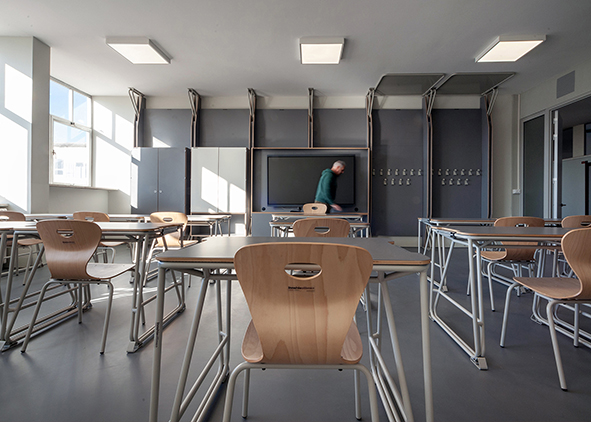
In areas of high seismic risk, school safety depends not only on the structural performance of buildings, but also on occupants’ ability to recognise and correctly use protective devices and operational procedures. With this in mind, the paper presents the development of an Immersive Learning Environment (ILE) conceived as a digital socio-technical infrastructure supporting the Life Saving Furniture System (LSFS), developed within the inter-university research programme Vitality. The ILE integrates virtual reality, 360° content and augmented reality, relying on a static digital twin of the classroom. The research adopts a design-led approach, combined with hybrid model-based pilot experimentation. Preliminary results suggest improved understanding of the LSFS, an overall positive usability profile, and encouraging indications of procedural responsiveness.
Article info
Received: 10/03/2026; Revised: 10/04/2026; Accepted: 13/04/2026
Downloads
Article Metrics Graph
References
Alexander, D. (1990), “Behavior during earthquakes – A Southern Italian example”, in International Journal of Mass Emergencies and Disasters, vol. 8, issue 1, pp. 5-29. [Online] Available at: doi.org/10.1177/028072709000800102 [Accessed 26 March 2026].
Bernardini, G., Quagliarini, E. and D’Orazio, M. (2016), “Towards creating a combined database for earthquake pedestrians’ evacuation models”, in Safety Science, vol. 82, pp. 77-94. [Online] Available at: doi.org/10.1016/j.ssci.2015.09.001 [Accessed 26 March 2026].
Canessa, N. V. and Centanaro, C. (2024), “Co(mplex)city – Utente come sensore urbano e mobilità accessibile nel progetto Mobiquity | Co(mplex)city – User as urban sensor and accessible mobility in the Mobiquity project”, in Agathón | International Journal of Architecture, Art and Design, vol. 16, pp. 88-97. [Online] Available at: doi.org/10.19229/2464-9309/1672024 [Accessed 26 March 2026].
Centers for Disease Control and Prevention (2024), Preparing for an earthquake. [Online] Available at: cdc.gov/earthquakes/safety/index.html [Accessed 26 March 2026].
Chittaro, L. and Buttussi, F. (2015), “Assessing knowledge retention of an immersive serious game vs. a traditional education method in aviation safety”, in IEEE Transactions on Visualization and Computer Graphics, vol. 21, issue 4, pp. 529-538. [Online] Available at: doi.org/10.1109/TVCG.2015.2391853 [Accessed 26 March 2026].
Chittaro, L. and Sioni, R. (2015), “Serious games for emergency preparedness – Evaluation of an interactive vs. a non-interactive simulation of a terror attack”, in Computers in Human Behavior, vol. 50, pp. 508-519. [Online] Available at: doi.org/10.1016/j.chb.2015.03.074 [Accessed 26 March 2026].
D’Amore, A. E. (2025), “Gemello digitale e processo edilizio – Riflessioni su produttività, energia e salute | The digital twin and the building process – Reflections on productivity, energy, and health”, in Agathón | International Journal of Architecture, Art and Design, vol. 18, pp. 144-161. [Online] Available at: doi.org/10.69143/2464-9309/1872025 [Accessed 26 March 2026].
Davidová, M., Barath, S. and Dickinson, S. (2023), “Ambienti culturali con prospettive non solo umane – Prototipazione attraverso ricerca e formazione | Cultural environments with more-than-human perspectives – Prototyping through research and training”, in Agathón | International Journal of Architecture, Art and Design, vol. 13, pp. 165-178. [Online] Available at: doi.org/10.19229/2464-9309/13142023 [Accessed 26 March 2026].
Feng, Z., González, V. A., Amor, R., Lovreglio, R. and Cabrera-Guerrero, G. (2018), “Immersive virtual reality serious games for evacuation training and research – A systematic literature review”, in Computers & Education, vol. 127, pp. 252-266. [Online] Available at: doi.org/10.1016/j.compedu.2018.09.002 [Accessed 26 March 2026].
Feng, Z., González, V. A., Amor, R., Spearpoint, M., Thomas, J., Sacks, R., Lovreglio, R. and Cabrera-Guerrero, G. (2020), “An immersive virtual reality serious game to enhance earthquake behavioral responses and post-earthquake evacuation preparedness in buildings”, in Advanced Engineering Informatics, vol. 45, article 101118, pp. 1-15. [Online] Available at: doi.org/10.1016/j.aei.2020.101118 [Accessed 26 March 2026].
Franzo, P., Quartu, A. and Tufarelli, M. (2025), “Re-shaping fashion in Italy – Sistemi circolari, scenari phygital e formazione informale | Re-shaping fashion in Italy – Circular systems, phygital scenarios, and informal education”, in Agathón | International Journal of Architecture, Art and Design, vol. 18, pp. 344-357. [Online] Available at: doi.org/10.69143/2464-9309/18212025 [Accessed 26 March 2026].
Giachetta, A. and Buondonno, L. (2024), “La formazione dell’Architetto in realtà complesse – Un nuovo approccio sul piano cognitivo | Architect training in multifaceted environments – A new cognitive level approach”, in Agathón | International Journal of Architecture, Art and Design, vol. 16, pp. 50-59. [Online] Available at: doi.org/10.19229/2464-9309/1642024 [Accessed 26 March 2026].
Hettinger, L. J. and Riccio, G. E. (1992), “Visually induced motion sickness in virtual environments”, in Presence | Teleoperators & Virtual Environments, vol. 1, issue 3, pp. 306-310. [Online] Available at: doi.org/10.1162/pres.1992.1.3.306 [Accessed 26 March 2026].
Hung, M.-C., Lin, C.-Y. and Hsiao, G. L.-K. (2025), “Virtual Reality in Building Evacuation – A Review”, in Fire, vol. 8, issue 2, article 80, pp. 1-23. [Online] Available at: doi.org/10.3390/fire8020080 [Accessed 26 March 2026].
ISO/IEC (2025), ISO/IEC 9234:2025 – Information technology – Information modelling for virtual, augmented and mixed reality based education and training systems. [Online] Available at: iso.org/standard/83436.html [Accessed 26 March 2026].
Kaggwa, M. M., Chaimowitz, G. A., Agboinghale, P., Marginean, D. and Olagunju, A. T. (2025), “Virtual reality training programs in disaster preparedness – A systematic review”, in Discover Education, vol. 4, article 325, pp. 1-15 [Online] Available at: doi.org/10.1007/s44217-025-00771-5 [Accessed 26 March 2026].
Keshavarz, B. (2016), “Exploring behavioral methods to reduce visually induced motion sickness in virtual environments”, in Lackey, S. and Shumaker, R. (eds), Virtual, Augmented and Mixed Reality – Proceedings of the 8th International Conference – VAMR 2016, Toronto, Canada, July 17-22, 2016, Lecture Notes in Computer Science, vol. 9740, Springer, Cham, pp. 147-155. [Online] Available at: doi.org/10.1007/978-3-319-39907-2_14 [Accessed 26 March 2026].
LaValle, S. M. (2023), Virtual Reality, Cambridge University Press, Cambridge.
Li, C., Liang, W., Quigley, C., Zhao, Y. and Yu, L.-F. (2017), “Earthquake safety training through virtual drills”, in IEEE Transactions on Visualization and Computer Graphics, vol. 23, issue 4, pp. 1275-1284. [Online] Available at: doi.org/10.1109/TVCG.2017.2656958 [Accessed 26 March 2026].
Lin, J., Zhu, R., Li, N. and Becerik-Gerber, B. (2020), “Do people follow the crowd in building emergency evacuation? – A cross-cultural immersive virtual reality-based study”, in Advanced Engineering Informatics, vol. 43, article 101040, pp. 1-13. [Online] Available at: doi.org/10.1016/j.aei.2020.101040 [Accessed 26 March 2026].
Liu, Q. and Liu, R. (2024), “Virtual reality for indoor emergency evacuation studies – Design, development, and implementation review”, in Safety Science, vol. 180, article 106678. [Online] Available at: doi.org/10.1016/j.ssci.2024.106678 [Accessed 26 March 2026].
Lovreglio, R., González, V. A., Feng, Z., Amor, R., Spearpoint, M., Thomas, J., Trotter, M. and Sacks, R. (2018), “Prototyping virtual reality serious games for building earthquake preparedness – The Auckland City Hospital case study”, in Advanced Engineering Informatics, vol. 38, pp. 670-682. [Online] Available at: doi.org/10.1016/j.aei.2018.08.018 [Accessed 26 March 2026].
Mezirow, J. (1997), “Transformative learning – Theory to practice”, in New Directions for Adult and Continuing Education, vol. 1997, issue 74, pp. 5-12. [Online] Available at: doi.org/10.1002/ace.7401 [Accessed 26 March 2026].
Nava, C. and Melis, A. (2024), “IA generativa e complessità – Verso un nuovo paradigma nel design digitale rigenerativo | Generative IA and complexity – Towards a new paradigm in regenerative digital design”, in Agathón | International Journal of Architecture, Art and Design, vol. 16, pp. 40-49. [Online] Available at: doi.org/10.19229/2464-9309/1632024 [Accessed 26 March 2026].
Peruccio, P. P., Liboni, M. and Mucchetti, F. (2025), “Il ruolo degli archivi d’impresa nell’era della blockchain e della IA | The role of corporate archives in the era of blockchain and AI”, in Agathón | International Journal of Architecture, Art and Design, vol. 17, pp. 348-359. [Online] Available at: doi.org/10.69143/2464-9309/17242025 [Accessed 26 March 2026].
Pietroni, L., Fabbri, I., Galloppo, D. and Balsamo, M. F. (2025), “Vitality Pilot Project – Una sperimentazione interdisciplinare per accrescere la sicurezza nelle scuole dei territori ad alto rischio sismico”, in Morone, A. (ed.), Design Plurale – Casi e modelli alternativi per l’innovazione – Atti Conferenza Nazionale di Design | Plural Design – Cases and alternative models for innovation – Proceedings Italian Design Society Conference, Naples, Italy, June 26-27, 2025, Federico II University Press, Napoli, pp. 218-233. [Online] Available at: pubblicazioni.unicam.it/retrieve/69cd7adc-6f11-479d-9a0a-f98c48b49a62/ATTI-SID-NAPOLI-2025_estratto-1.pdf [Accessed 26 March 2026].
Pietroni, L., Mascitti, J. and Galloppo, D. (2021), “Arredi salva-vita in caso di sisma – Intelligenti, interconnessi e interagenti | Life-saving furniture during an earthquake – Intelligent, interconnected and interacting”, in Agathón | International Journal of Architecture, Art and Design, vol. 10, pp. 218-229. [Online] Available at: doi.org/10.19229/2464-9309/10202021 [Accessed 26 March 2026].
Rajabi, M. S., Taghaddos, H. and Zahrai, S. M. (2022), “Improving Emergency Training for Earthquakes Through Immersive Virtual Environments and Anxiety Tests – A Case Study”, in Buildings, vol. 12, issue 11, article 1850, pp. 1-22. [Online] Available at: arxiv.org/abs/2205.04993 [Accessed 26 March 2026].
Scorgie, D., Feng, Z., Paes, D., Parisi, F., Yiu, T. W. and Lovreglio, R. (2024), “Virtual reality for safety training – A systematic literature review and meta-analysis”, in Safety Science, vol. 171, article 106372, pp. 1-13. [Online] Available at: doi.org/10.1016/j.ssci.2023.106372 [Accessed 26 March 2026].
Sitzmann, T. (2011), “A meta-analytic examination of the instructional effectiveness of computer-based simulation games”, in Personnel Psychology, vol. 64, issue 2, pp. 489-528. [Online] Available at: doi.org/10.1111/j.1744-6570.2011.01190.x [Accessed 26 March 2026].
Stefan, H., Mortimer, M. and Horan, B. (2023), “Evaluating the effectiveness of virtual reality for safety-relevant training – A systematic review”, in Virtual Reality, vol. 27, issue 4, pp. 2839-2869. [Online] Available at: doi.org/10.1007/s10055-023-00843-7 [Accessed 26 March 2026].
Vacanti, A., De Chirico, M., Crippa, D. and Fagnoni, R. (2025), “Temporalità digitale – La responsabilità dell’Interaction Design nell’alienazione digitale | Digital temporality – The responsibility of Interaction Design in digital alienation”, in Agathón | International Journal of Architecture, Art and Design, vol. 17, pp. 336-347. [Online] Available at: doi.org/10.69143/2464-9309/17232025 [Accessed 26 March 2026].
Valenti, A., Scalisi, F., Sposito, C., Colaci, D. F. and Moor, G. (2025), “Design, tecnologia e povertà – Dispositivi per il progetto di architetture, oggetti e società | Design, technology, and poverty – Devices for the design of architecture, objects, and society”, in Agathón | International Journal of Architecture, Art and Design, vol. 17, pp. 42-67. [Online] Available at: doi.org/10.69143/2464-9309/1722025 [Accessed 26 March 2026].
Wang, J., Samarasinghe, D. A., Aquino, D. H. M. and Ying, F. (2026), “A Systematic Review of Digital Technologies for Emergency Preparedness in Buildings”, in Buildings, vol. 16, issue 4, article 856, pp. 1-29. [Online] Available at: doi.org/10.3390/buildings16040856 [Accessed 26 March 2026].
Wouters, P., van Nimwegen, C., van Oostendorp, H. and van der Spek, E. D. (2013), “A meta-analysis of the cognitive and motivational effects of serious games”, in Journal of Educational Psychology, vol. 105, issue 2, pp. 249-265. [Online] Available at: doi.org/10.1037/a0031311 [Accessed 26 March 2026].
Xu, Z., Zhang, H., Wei, W. and Yang, Z. (2019), “Virtual Scene Construction for Seismic Damage of Building Ceilings and Furniture”, in Applied Sciences, vol. 9, issue 17, article 3465, pp. 1-21. [Online] Available at: doi.org/10.3390/app9173465 [Accessed 26 March 2026].
Zehr Gantz, S., Massari, S., McDonagh, D. and Vokoun, J. (2025), “Affrontare l’insicurezza alimentare – Empatia e Design Thinking per l’apprendimento trasformativo | Addressing food insecurity – Leveraging empathy and Design Thinking to achieve transformative learning”, in Agathón | International Journal of Architecture, Art and Design, vol. 17, pp. 384-397. [Online] Available at: doi.org/10.69143/2464-9309/17272025 [Accessed 26 March 2026].
Downloads
Published
How to Cite
Issue
Section
Categories
License
Copyright (c) 2026 Federico Orfeo Oppedisano, Daniele Rossi, Manuel Scortichini

This work is licensed under a Creative Commons Attribution 4.0 International License.
This Journal is published under Creative Commons Attribution Licence 4.0 (CC-BY).
License scheme | Legal code
This License allows anyone to:
Share: copy and redistribute the material in any medium or format.
Adapt: remix, transform, and build upon the material for any purpose, even commercially.
Under the following terms
Attribution: Users must give appropriate credit, provide a link to the license, and indicate if changes were made; users may do so in any reasonable manner, but not in any way that suggests the licensor endorses them or their use.
No additional restrictions: Users may not apply legal terms or technological measures that legally restrict others from doing anything the license permits.
Notices
Users do not have to comply with the license for elements of the material in the public domain or where your use is permitted by an applicable exception or limitation.
No warranties are given. The license may not give users all of the permissions necessary for their intended use. For example, other rights such as publicity, privacy, or moral rights may limit how you use the material.