Automotive-AEC technology transfer – DfMA framework and complex façade systems
DOI:
https://doi.org/10.69143/2464-9309/19162026Keywords:
technology transfer, industrialisation of complexity, façade systems, topological optimisation, life cycle assessmentAbstract
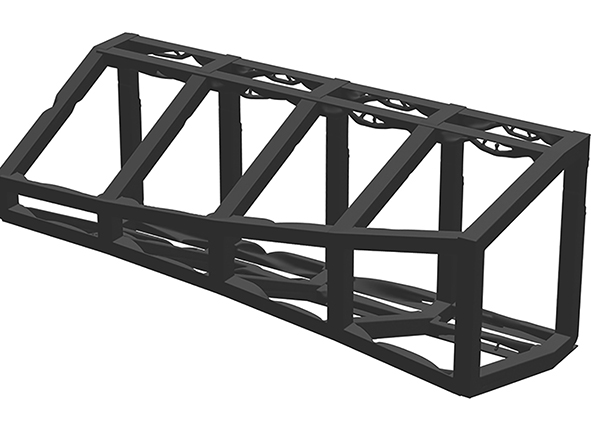
In the AEC sector, there is an urgent need for solutions that integrate environmental sustainability, design quality, and production scalability. This urgency stems from a rapidly changing context marked by environmental and technological shifts, a shortage of skilled labour, and stagnant productivity. Transferring technology from the automotive to the construction sector serves as a strategic lever for managing the growing complexity of building envelopes. This paper introduces an automotive-derived Design for Manufacturing and Assembly framework. The framework is applied to a façade macro-component fabricated from Glass-fibre Reinforced Concrete and Wire Arc Additive Manufacturing. By integrating parametric modelling, topological optimisation, and Life Cycle Assessment, the approach reduces the substructure’s mass. This improves material efficiency and guides the project towards industrialisable solutions that align with circularity principles.
Article info
Received: 10/03/2026; Revised: 11/04/2026; Accepted: 13/04/2026
Downloads
Article Metrics Graph
References
Ahmad, J., González-Lezcano, R. A., Majdi, A., Ben Kahla, N., Deifalla, A. F. and El-Shorbagy, M. A. (2022), “Glass fibers re-inforce concrete – Overview on mechanical, durability and microstructure analysis”, in Materials, vol. 15, issue 15, article 5111, pp. 1-23. [Online] Available at: doi.org/10.3390/ma15155111 [Accessed 31 March 2026].
Alkhazaleh, R., Mykoniatis, K. and Alahmer, A. (2022), “The success of technology transfer in the Industry 4.0 era – A sys-tematic literature review”, in Journal of Open Innovation | Technology, Market, and Complexity, vol. 8, issue 4, article 202, pp. 1-18. [Online] Available at: doi.org/10.3390/joitmc8040202 [Accessed 31 March 2026].
Bendsøe, M. P. and Sigmund, O. (2004), Topology Optimization – Theory, Methods and Applications, Springer, Berlin. [Online] Available at: doi.org/10.1007/978-3-662-05086-6 [Accessed 31 March 2026].
Bentur, A. and Mindess, S. (2006), Fibre Reinforced Cementitious Composites, CRC Press, Boca Raton. [Online] Available at: doi.org/10.1201/9781482267747 [Accessed 8 April 2026].
Bishop, E. and Wilson, J. (2011), “Concept to realisation – GRC and complex facades”, in Proceedings of the GRCA Con-gress 2011, Istanbul, Turkey, September 4-8, 2011, Glassfibre Reinforced Concrete Association, Bingley, pp. 1-15. [Online] Available at: grca.org.uk/pdf/congress-2011/21%20Concept%20to%20Realisation%20GRC%20and%20Complex %20Facades.pdf [Accessed 31 March 2026].
Damtsas, E., Nieto Jiménez, A., Konstantatou, M., Herrmann, M. and Grigoriadis, K. (2025), “The design, fabrication, and structural and embodied carbon analysis of the world’s first manufactured topologically optimised multi-metal I-beam”, in Architectural Intelligence, vol. 4, issue 1, article 23, pp. 1-22. [Online] Available at: doi.org/10.1007/s44223-025-00100-8 [Accessed 31 March 2026].
de Matos Camarinha, R., Goulding, J. and Peter, C. (2023), “Construction sector transformation – Developing a new learning paradigm”, in Gomes Correia, A., Azenha, M., Cruz, P. J. S., Novais, P. and Pereira, P. (eds), Trends on Construction in the Dig-ital Era – ISIC 2022 – Proceedings of ISIC 2022, Guimarães, Portugal, September 6-9, 2022, Lecture Notes in Civil Engi-neering, vol. 306, Springer, Cham, pp. 369-379. [Online] Available at: doi.org/10.1007/978-3-031-20241-4_25 [Accessed 31 March 2026].
Ettlie, J. E. and Elsenbach, J. M. (2007), “Modified Stage-Gate® regimes in new product development”, in Journal of Product Innovation Management, vol. 24, issue 1, pp. 20-33. [Online] Available at: doi.org/10.1111/j.1540-5885.2006.00230.x [Ac-cessed 31 March 2026].
European Committee for Standardization (2019), EN 15804 – Sustainability of construction works – Environmental product declarations – Core rules for the product category of construction products. [Online] Available at: stand-ards.iteh.ai/catalog/standards/cen/c98127b4-8dc2-48a4-9338-3e1366b16669/en-15804-2012a2-2019 [Accessed 31 March 2026].
European Committee for Standardization (2011), EN 15978 – Sustainability of construction works – Assessment of envi-ronmental performance of buildings – Calculation method. [Online] Available at: stand-ards.iteh.ai/catalog/standards/cen/62c22cef-5666-4719-91f9-c21cb6aa0ab3/en-15978-2011 [Accessed 31 March 2026].
Giovanardi, M., Castellan, C., La Rosa, M., Pavlovic, A. and Pracucci, A. (2024), “Progettare BIPV – Strategie per gestire la complessità del fotovoltaico integrato in facciata | Designing BIPV – Strategies for managing complexity in the integration of photovoltaics in facades”, in Agathón | International Journal of Architecture, Art and Design, vol. 16, pp. 186-193. [Online] Available at: doi.org/10.19229/2464-9309/16152024 [Accessed 31 March 2026].
Henriksen, T., Lo, S. and Knaack, U. (2015), “An innovative approach to manufacture thin-walled glass fibre reinforced con-crete for tomorrow’s architectural building envelopes with complex geometries”, in Journal of Building Engineering, vol. 4, pp. 189-199. [Online] Available at: doi.org/10.1016/j.jobe.2015.09.006 [Accessed 31 March 2026].
Höweler, E. (2025), Design for Construction – Tectonic Imagination in Contemporary Architecture, Routledge, London. [Online] Available at: doi.org/10.4324/9781003434559 [Accessed 31 March 2026].
ISO – International Organization for Standardization (2006a), ISO 14040:2006 – Environmental management – Life cycle assessment – Principles and framework. [Online] Available at: iso.org/standard/37456.html [Accessed 31 March 2026].
ISO –International Organization for Standardization (2006b), ISO 14044:2006 – Environmental management – Life cycle assessment – Requirements and guidelines. [Online] Available at: iso.org/standard/38498.html [Accessed 31 March 2026].
Laghi, V., Palermo, M., Bruggi, M., Gasparini, G. and Trombetti, T. (2023), “Blended structural optimization for wire-and-arc additively manufactured beams”, in International Journal of Steel Structures, vol. 8, pp. 381-392. [Online] Available at: doi.org/10.1007/s40964-022-00335-1 [Accessed 31 March 2026].
Laghi, V., Savino, E. and Gasparini, G. (2025), “Reduction of the environmental impact of complex-shaped steel joints through topology optimization and large-scale metal 3D printing”, in Results in Engineering, vol. 27, article 105610, pp. 1-14. [Online] Available at: doi.org/10.1016/j.rineng.2025.105610 [Accessed 31 March 2026].
Manni, V. and Valzano, L. S. (2023), “Modularità e architettura adattiva – Una strategia per la gestione di sistemi d’involucro complessi | Modularity and adaptive architecture – A strategy for managing complex envelope systems”, in Agathón | Interna-tional Journal of Architecture, Art and Design, vol. 14, pp. 134-151. [Online] Available at: doi.org/10.19229/2464-9309/14112023 [Accessed 31 March 2026].
Morbiducci, R., Polverino, S. and Battaglia, C. (2023), “Stampa 4D per componenti costruttivi modulari – Applicazioni e prin-cipali sviluppi | 4D printing for modular construction components – Applications and main developments”, in Agathón | In-ternational Journal of Architecture, Art and Design, vol. 14, pp. 182-193. [Online] Available at: doi.org/10.19229/2464-9309/14152023 [Accessed 31 March 2026].
Onat, M. (2025), “Investigation of changes in body-in-white components and their impact during the transition from internal combustion engine vehicles to electric vehicles”, in International Journal of Automotive Engineering and Technologies, vol. 14, issue 2, pp. 123-141. [Online] Available at: doi.org/10.18245/ijaet.1630727 [Accessed 31 March 2026].
Osello, A., Del Giudice, M., Donato, A. J. and Fratto, A. (2024), “Verso la Neutralità Climatica – Il ruolo chiave del Digital Twin nell’Industria 5.0 | Towards Climate Neutrality – The key role of the Digital Twin in Industry 5.0”, in Agathón | Inter-national Journal of Architecture, Art and Design, vol. 15, pp. 276-285. [Online] Available at: doi.org/10.19229/2464-9309/15222024 [Accessed 8 April 2026].
Palumbo, E., Mazzei, I., Perpetua, M. and Pomponi, F. (2025), “Impatti ambientali e sociali nel ciclo vita per una progettazione a basso carbonio | Environmental and social life cycle for low-carbon design”, in Agathón | International Journal of Archi-tecture, Art and Design, vol. 18, pp. 294-303. [Online] Available at: doi.org/10.69143/2464-9309/18172025 [Accessed 31 March 2026].
Paoletti, I. (2003), Una finestra sul trasferimento – Tecnologie innovative per l’architettura, Libreria Clup, Milano.
Purslow, G. J. (1990), “Stud frame cladding – A technical appraisal”, in Construction and Building Materials, vol. 4, issue 1, pp. 11-15. [Online] Available at: doi.org/10.1016/0950-0618(90)90013-Q [Accessed 31 March 2026].
Raspall, F., Araya, S., Pazols, M., Valenzuela, E., Castillo, M. and Benavides, P. (2025), “Wire arc additive manufacturing for widespread architectural application – A review informed by large-scale prototypes”, in Buildings, vol. 15, issue 6, article 906, pp. 1-21. [Online] Available at: doi.org/10.3390/buildings15060906 [Accessed 31 March 2026].
RIBA – Royal Institute of British Architects (2020), RIBA Plan of Work 2020 Overview, RIBA, London. [Online] Available at: riba.org/media/syneeeto/2020ribaplanofworkoverviewpdf.pdf [Accessed 8 April 2026].
Richard, R.-B. (2017), “Industrialized building system categorization”, in Smith, R. E. and Quale, J. D. (eds), Offsite Architec-ture – Constructing the future, Routledge, London, pp. 3-20. [Online] Available at: doi.org/10.4324/9781315743332-1 [Ac-cessed 31 March 2026].
Samad, M. F. A. and George, K. Y. (2022), “Application of Design for Manufacturing and Assembly (DFMA) method to vehi-cle door design”, in Defence S and T Technical Bulletin, vol. 15, issue 1, pp. 34-41. [Online] Available at: eprints.utem.edu.my/id/eprint/26996/ [Accessed 31 March 2026].
Shah, I. H., Hadjipantelis, N., Walter, L., Myers, R. J. and Gardner, L. (2023), “Environmental life cycle assessment of wire arc additively manufactured steel structural components”, in Journal of Cleaner Production, vol. 389, article 136071, pp. 1-14. [Online] Available at: doi.org/10.1016/j.jclepro.2023.136071 [Accessed 31 March 2026].
Smith, R. E., Elliott, J. W. and Grosskopf, K. (2017), “Offsite construction in education – A survey of prefabrication in design and construction academia”, in Smith, R. E. and Quale, J. D. (eds), Offsite Architecture – Constructing the future, Routledge, London, pp. 128-138. [Online] Available at: doi.org/10.4324/9781315743332-8 [Accessed 31 March 2026].
Spreafico, C., Kokare, S. and Godina, R. (2026), “Prospective life cycle assessment of future wire arc additive manufacturing deposition process for large-scale steel parts”, in Environmental Impact Assessment Review, vol. 116, article 108111, pp. 1-17. [Online] Available at: doi.org/10.1016/j.eiar.2025.108111 [Accessed 31 March 2026].
Takezawa, A., Nishiwaki, S. and Kitamura, M. (2010), “Shape and topology optimization based on the phase field method and sensitivity analysis”, in Journal of Computational Physics, vol. 229, issue 7, pp. 2697-2718. [Online] Available at: doi.org/10.1016/j.jcp.2009.12.017 [Accessed 31 March 2026].
UN – United Nations (2015), Transforming our World – The 2030 Agenda for Sustainable Development. [Online] Available at: sdgs.un.org/2030agenda [Accessed 31 March 2026].
Vibæk, K. S. (2017), “System structures – A theory of industrialised architecture”, in Smith, R. E. and Quale, J. D. (eds), Offsite Architecture – Constructing the future, Routledge, London, pp. 21-36. [Online] Available at: doi.org/10.4324/9781315743332-2 [Accessed 31 March 2026].
Waqar, A., Al Hajj, F., Danish, M., Khan, M. B. and Houda, M. (2025), “Evaluating the influence of modern construction methods on sustainable construction success”, in Cleaner and Responsible Consumption, vol. 19, article 100327, pp. 1-14. [Online] Available at: doi.org/10.1016/j.clrc.2025.100327 [Accessed 9 April 2026].
Wood, B. (2021), Data Driven Infrastructure – From Digital Tools to Manufactured Components. [Online] Available at: cdbb.cam.ac.uk/system/ files/documents/data_driven_infrastructure_screen.pdf [Accessed 8 April 2026].
Downloads
Published
How to Cite
Issue
Section
Categories
License
Copyright (c) 2026 Ingrid Maria Paoletti, Giuseppe Conti, Giorgio Castellano, Federica Pradella

This work is licensed under a Creative Commons Attribution 4.0 International License.
This Journal is published under Creative Commons Attribution Licence 4.0 (CC-BY).
License scheme | Legal code
This License allows anyone to:
Share: copy and redistribute the material in any medium or format.
Adapt: remix, transform, and build upon the material for any purpose, even commercially.
Under the following terms
Attribution: Users must give appropriate credit, provide a link to the license, and indicate if changes were made; users may do so in any reasonable manner, but not in any way that suggests the licensor endorses them or their use.
No additional restrictions: Users may not apply legal terms or technological measures that legally restrict others from doing anything the license permits.
Notices
Users do not have to comply with the license for elements of the material in the public domain or where your use is permitted by an applicable exception or limitation.
No warranties are given. The license may not give users all of the permissions necessary for their intended use. For example, other rights such as publicity, privacy, or moral rights may limit how you use the material.