Resilient management of stormwater – A tool to support design
DOI:
https://doi.org/10.69143/2464-9309/18102025Keywords:
stormwater management, architectural and urban resilience, simulation and modelling, environmental technological design, design support toolAbstract
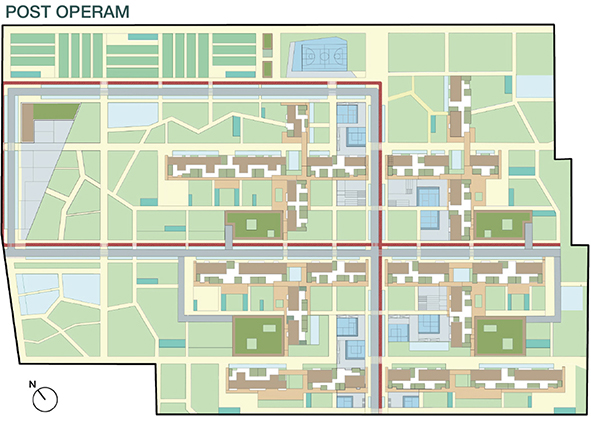
Climate change is causing increasingly intense extreme weather events, with sudden floods alternating with long periods of drought. The impermeabilisation of soils amplifies runoff and strains traditional drainage systems. In this context, the Water Management systems (WMs) was developed as a parametric tool to support the preliminary design of resilient stormwater management solutions. Developed from a critical analysis of existing tools and based on a structured database of technical data and regulations, the WMs is implemented in Rhino-Grasshopper and integrated with spreadsheets. The tool enables the modelling and verification of multiple solutions and scenarios based on contextual conditions, supporting informed design decisions, as demonstrated in a pilot project.
Article info
Received: 12/09/2025; Revised: 22/10/2025; Accepted: 24/10/2025
Downloads
Article Metrics Graph
References
ASTEE – Association Scientifique et Technique pour l’Eau et l’Environnement (2017), Mémento technique 2017 – Conception et dimensionnement des systèmes de gestion des eaux pluviales et de collecte des eaux usées. [Online] Available at: astee.org/publications/memento-technique-2017/ [Accessed 28 September 2025].
Claghorn, J. (2016), “Water runoff script – Example 8.6”, in Generative Landscape, 31/05/2006. [Online] Available at: generative-landscapes.com/water-runoff-script-example-8-6/ [Accessed 28 September 2025].
Dierna, S. (1995), “Tecnologie del progetto ambientale, per una trasformazione sostenibile”, in Sala, M. (ed.), Teaching in Architecture Energy and Environment World Network – Proceedings of the Florence International Conference for Teachers of Architecture, Firenze, Italy, September 28-30, 1995, Alinea Editrice, Firenze, article 4.03.
EEA – European Environment Agency (2024), European Climate Risk Assessment – Executive Summary, EEA Report 01/2024. [Online] Available at: eea.europa.eu/en/analysis/publications/european-climate-risk-assessment [Accessed 28 September 2025].
Ferrari, E. and Versace, P. (eds) (1994), La valutazione delle piene in Italia – Rapporto nazionale di sintesi. [Online] Available at: idrologia.polito.it/gndci/rapportiPdf/Vapi_Nazionale.pdf [Accessed 28 September 2025].
Ibrahim, Y. I., Kershaw, T. and Shepherd, P. (2020), “A Methodology for Modelling Microclimate – A Ladybug-tools and ENVI-met Verification Study”, in 35th Plea Conference Sustainable Architecture and Urban Design – A Coruña, Spain, 01/09/20-03/09/20. [Online] Available at: purehost.bath.ac.uk/ws/portalfiles/portal/212194165/A_methodology_ For_Modelling_Microclimate._A_Ladybug_tools_and_ENVI_met_ Verification_Study.pdf [Accessed 28 September 2025].
Leskens, J. G., Brugnach, M. and Hoekstra, A. Y. (2014), “Application of an Interactive Water Simulation Model in urban water management – A case study in Amsterdam”, in Water Science and Technology, vol. 70, issue 11, pp. 1729-1739. [Online] Available at: doi.org/10.2166/wst.2014.240 [Accessed 28 September 2025].
Marin, P. (2018), “D’une conception informée par des données à la généralisation des systèmes cyber-physiques”, in Les Cahiers de la recherche architecturale urbaine et paysagère, vol. 3, pp. 66-83. [Online] Available at: doi.org/10.4000/craup.1043 [Accessed 28 September 2025].
Masson-Delmotte, V., Zhai, P., Pirani, A., Connors, S. L., Péan, C., Chen, Y., Goldfarb, L., Gomis, M. I., Matthews, J. B. R., Berger, S., Huang, M., Yelekci, O., Yu, R., Zhou, B., Lonnoy, E., Maycock, T. K., Waterfield, T., Leitzell, K. and Caud, N. (eds) (2021), Climate Change 2021 – The Physical Science Basis – Contribution of Working Group I to the Sixth Assessment Report of the Intergovernmental Panel on Climate Change, Cambridge University Press, Cambridge (UK) and New York (NY). [Online] Available at: doi.org/10.1017/9781009157896 [Accessed 28 September 2025].
Morschek, J., König, R. and Schneider, S. (2019), “An integrated urban planning and simulation method to enforce spatial resilience towards flooding hazards”, in SimAUD 2019 – 10th Symposium on Simulation for Architecture and Urban Design, Atlanta, Georgia, April 7-9, 2019, Society for Computer Simulation International, San Diego (CA), article 10, pp. 1-8. [Online] Available at: dl.acm.org/doi/pdf/10.5555/3390098.3390108 [Accessed 28 September 2025].
Nava, C. and Melis, A. (2024), “IA generativa e complessità – Verso un nuovo paradigma nel design digitale rigenerativo | Generative IA and complexity – Towards a new paradigm in regenerative digital design”, in Agathón | International Journal of Architecture, Art and Design, vol. 16, pp. 40-49. [Online] Available at: doi.org/10.19229/2464-9309/1632024 [Accessed 28 September 2024].
Negretto, V., Giacomello, E., Gava, B. and Romanato, N. (2021), Linee guida per il Drenaggio Urbano Sostenibile – Tecniche e principi per la pianificazione urbanistica, Corila, Venezia. [Online] Available at: air.iuav.it/retrieve/de164c2b-acdb-60ee-e053-3a05fe0a7787/Linee%20guida%20per%20il%20drenaggio%20urbano%20 sostenibile_web.pdf [Accessed 28 September 2025].
Tucci, F., Cecafosso, V., Altamura, P. and Giampaoletti, M. (2022), “Simulazione e modellazione per l’adattamento e la mitigazione climatica – Esperienze di riqualificazione ambientale a Roma | Simulation and modelling for climate adaptation and mitigation – Experiences of environmental renovation in Rome”, in Agathón – International Journal of Architecture, Art and Design, vol. 12, pp. 106-121. [Online] Available at: doi.org/10.19229/2464-9309/12102022 [Accessed 28 September 2025].
Un-Habitat (2024), Cities and Climate Action – World Cities Report 2024. [Online] Available at: unhabitat.org/sites/default/files/2024/11/wcr2024_-_full_report.pdf [Accessed 28 September 2025].
UN – United Nations (2015), Transforming our World – The 2030 Agenda for Sustainable Development – A/RES/70/1, United Nations, New York. [Online] Available at: sustainabledevelopment.un.org/post2015/transformingourworld/publication [Accessed 28 September 2025].
Vahid, A., Qaddumi, H. M., Dickson, E., Diez, S. M., Danilenko, A. V., Hirji, R. F., Puz, G., Pizarro, C., Jacobsen, M. and Blankespoor, B. (2009), Water and climate change – Understanding the risks and making climate-smart investment decisions. [Online] Available at: documents1.worldbank.org/curated/en/362051468328208633/pdf/529 110NWP0Box31ge0web0large01128110.pdf [Accessed 28 September 2025].
Valente, R., Mozingo, L. A., Bosco, R. and Giacobbe, S. (2024), “Gestione integrata delle risorse naturali in contesti urbani sostenibili | Integrated natural resource management in sustainable urban context”, in Agathón | International Journal of Architecture, Art and Design, vol. 15, pp. 180-189. [Online] Available at: doi.org/10.19229/2464-9309/15142024 [Accessed 28 September 2025].
WMO – World Meteorological Organization (2021), 2021 State of climate services – Water. [Online] Available at: library.wmo.int/viewer/57630/download?file=1278_en.pdf&type=pdf&navigator=1 [Accessed 28 September 2025].
Woods-Ballard, B., Wilson, S., Udale-Clarke, H., Hillman, S., Scott, T., Ashley, R. and Kellagher, R. (2015), The SUDS Manual, CIRIA, London (UK). [Online] Available at: ciria.org/CIRIA/Books/Free_publications/C753F.aspx [Accessed 28 September 2025].
Zarcone, R., Nava, F. and Tucci, F. (2024), “Mitigazione del clima e comfort umano – Uno strumento per la modellazione e simulazione di supporto alle decisioni | Climate mitigation and human comfort – A decision-support modeling and simulation tool”, in Agathón | International Journal of Architecture, Art and Design, vol. 15, pp. 228-237. [Online] Available at: doi.org/10.19229/2464-9309/15182024 [Accessed 28 September 2025].
Downloads
Published
How to Cite
Issue
Section
Categories
License
Copyright (c) 2025 Philippe Marin, Lidia Maria Giannini, Fabrizio Tucci

This work is licensed under a Creative Commons Attribution 4.0 International License.
This Journal is published under Creative Commons Attribution Licence 4.0 (CC-BY).
License scheme | Legal code
This License allows anyone to:
Share: copy and redistribute the material in any medium or format.
Adapt: remix, transform, and build upon the material for any purpose, even commercially.
Under the following terms
Attribution: Users must give appropriate credit, provide a link to the license, and indicate if changes were made; users may do so in any reasonable manner, but not in any way that suggests the licensor endorses them or their use.
No additional restrictions: Users may not apply legal terms or technological measures that legally restrict others from doing anything the license permits.
Notices
Users do not have to comply with the license for elements of the material in the public domain or where your use is permitted by an applicable exception or limitation.
No warranties are given. The license may not give users all of the permissions necessary for their intended use. For example, other rights such as publicity, privacy, or moral rights may limit how you use the material.