Beyond function – Water as a principle of equity, care, and urban and landscape identity
DOI:
https://doi.org/10.69143/2464-9309/1822025Keywords:
water architecture, urban design, responsive infrastructure, urban ecosystem, water equityAbstract
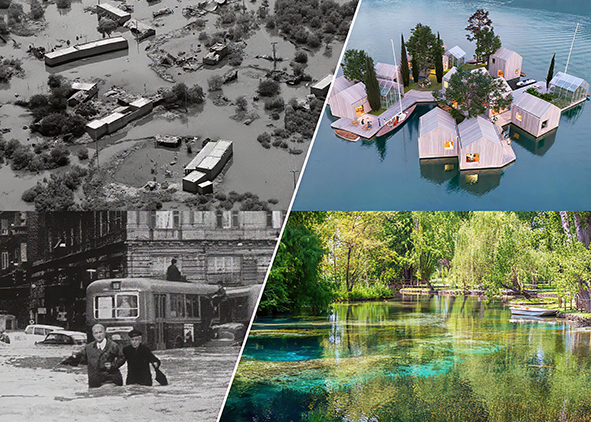
The issue of water is a challenge and a gamble, but inevitably, its governance must measure itself against a project for the future and the lessons of history. Approaching the future from within an emergency-driven perspective means grasping the articulated nature of an epochal problem and recognising the different technological and cultural perspectives that not only lead to solutions but also justify them. The contribution therefore investigates the ethical value of water as a design principle in contemporary design, highlighting the state of detachment of water infrastructures in the urban and landscape context. The results demonstrate a widespread field of experimentation, confirmed by the contemporary case studies presented, oriented towards overcoming the separation between infrastructure and urban landscape, redefining the role of design as an act of care and responsibility towards resources and inhabited places.
Article info
Received: 10/09/2025; Revised: 26/10/2025; Accepted: 27/10/2025
Downloads
Article Metrics Graph
References
Alamanos, A., Xenarios, S., Assubayeva, A., Landis, C. F. M., Dellis, K. and Koundouri, P. (2025), “Systems-thinking innovations for water security”, in Frontiers in Water, vol. 6, article 1492698, pp. 1-9. [Online] Available at: doi.org/10.3389/frwa.2024.1492698 [Accessed 30 September 2025].
ASviS – Alleanza Italiana per lo Sviluppo Sostenibile (2025), Pace Giustizia e diritti – Pilastri della sostenibilità – L’Italia e gli Obiettivi di Sviluppo Sostenibile, Rapporto AsviS 2025. [Online] Available at: asvis.it/rapporto-asvis-2025 [Accessed 25 October 2025].
ASviS – Alleanza Italiana per lo Sviluppo Sostenibile (2023), Gli insediamenti urbani nel Piano Nazionale di Adattamento ai Cambiamenti Climatici, position paper elaborato dal Gruppo di Lavoro sul Goal 11. [Online] Available at: asvis.it/public/asvis2/files/Pubblicazioni/PositionPaper/2023/PositionPaper ASviSGoal11_Pnacc_Insediamenti_Urbani_nov2023.pdf [Accessed 25 October 2025].
Bachelard, G. (1942), L’eau et les rêves – Essai sur l’imagination de la matière, José Corti, Paris.
Baratta, A.F. L., Finucci, F. and Magarò, A. (2025), “Povertà e infrastrutture idriche – Un caso studio nell’Africa Subsahariana | Poverty and water infrastructure – A case study in Sub-Saharan Africa”, in Agathón | International Journal of Architecture, Art and Design, vol. 17, pp. 284-295. [Online] Available at: doi.org/10.69143/2464-9309/17192025 [Accessed 25 October 2025].
Blanc, F. (2020), “Patrimoni in divenire – Progettare la loro rigenerazione | Heritages in progress – Designing their regeneration”, in Agathón | International Journal of Architecture, Art and Design, vol. 8, pp. 54-63. [Online] Available at: doi.org/10.19229/2464-9309/852020 [Accessed 30 September 2025]
Carter, M., Ianiri, F. and Mariano, M. (2024), “Tattiche di resilienza per ambiti urbani costieri – La Marina di Latina e il Porto di New York | Resilience tactics for coastal urban areas – The Marina di Latina and the New York Harbour”, in Agathón | International Journal of Architecture, Art and Design, vol. 16, pp. 156-173. [Online] Available at: doi.org/10.19229/2464-9309/16132024 [Accessed 25 October 2025].
Cea, L. and Costabile, P. (2022), “Flood Risk in Urban Areas – Modelling, Management and Adaptation to Climate Change – A Review”, in Hydrology, vol. 9, issue 3, article 50, pp. 1-35. [Online] Available at: doi.org/10.3390/hydrology9030050 [Accessed 30 September 2025].
Corradi, M., Stevens, T., Macaione, I., Raffa, A. and Andaloro, B. (2024), “Rigenerazione climatica green degli streetscapes – L’esperienza di De Urbanisten ad Anversa | Green climate-adaptive streetscapes regeneration – The De Urbanisten Experience in Antwerp”, in Agathón | International Journal of Architecture, Art and Design, vol. 16, pp. 60-73. [Online] Available at: doi.org/10.19229/2464-9309/1652024 [Accessed 25 October 2025].
D’Amelio, M. G. (2009), “La sorgente dell’Acqua Acetosa fuori Porta del Popolo a Roma – Medicina, Architettura e Architettura del Paesaggio”, in Bonaccorso, G. (ed.), Le acque e la città (XV-XVI secolo), CROMA, Roma, pp. 167-183. [Online] Available at: academia.edu/1981768/La_sorgente_dell_Acqua_Acetosa_fuori_Porta_del_ Popolo_a_Roma_medicina_architettura_and_architettura_del_paesaggio _XVI_XVII_secc_in_Roma_Moderna_e_Contemporanea_Università_Roma _Tre_CROMA_XVII_2009_1_2_2010_pp_167_183_ISBN_9788883681127 [Accessed 30 September 2025].
Daniel, A. D. and Fernandes, J. (2024), “Promotion of community resilience – Do citizens have a role to play? ”, in Local Environment | The International Journal of Justice and Sustainability, vol. 29, issue 8, pp. 987-1003. [Online] Available at: doi.org/10.1080/13549839.2024.2345621 [Accessed 30 September 2025].
De Francesco, G. (2022), “Infrastrutture dell’acqua – Nuove ecologie progettate”, in Archi, vol. 1, pp. 19-23. [Online] Available at: espazium.ch/it/archi1-22_de_francesco_progettare_l_acqua [Accessed 30 September 2025].
Di Carlo, F., Giancotti, A. and Reale, L. (2020), “Re-Inventing Water-Ground Relations in Landscape Architecture Projects”, in Sustainability, vol. 12, issue 24, article 10358, pp. 1-21. [Online] Available at: doi.org/10.3390/su122410358 [Accessed 30 September 2025].
Fortier, B. (1983), “La nascita dell’École des Ponts et Chaussées – 2 – Il progetto”, in Casabella, vol. 496, pp. 36-45.
Hoekstra, A. Y., Buurman, J. and van Ginkel, K. C. H. (2018), “ Urban water security – A review ”, in Environmental Research Letters, vol. 13, issue 5, article 053002, pp. 1-14. [Online] Available at: doi.org/10.1088/1748-9326/aaba52 [Accessed 30 September 2025].
Iliadis, C., Glenis, V. and Kilsby, C. (2024), “A cost-benefit ‘source-receptor’ framework for implementation of Blue-Green flood risk management”, in Journal of Hydrology, vol. 634, article 13113, pp. 1-12. [Online] Available at: doi.org/10.1016/j.jhydrol.2024.131113 [Accessed 30 September 2025].
Kaldor, G. (2024), “Città spugna – Funzionano davvero? Intervista al padre delle sponge cities”, in Materia rinnovabile | Renewable Matter, newspaper online, 08/10/2024. [Online] Available at: renewablematter.eu/citta-spugna-funzionano-davvero-intervista-al-padre-delle-sponge-cities [Accessed 30 September 2024].
Kongjian, Y. (2024), “Sponge Synergy – Huaiyang Fuxi Cultural Park in Zhoukou, China”, in Landscape Architecture Frontiers, vol. 12, issue 3, pp. 103-106. [Online] Available at: doi.org/10.15302/J-LAF-0-040004 [Accessed 30 September 2025].
Lautman, V. (2017), The Vanishing Stepwells of India, Merrell Publishers, London.
Meisch, S. P. (2019), “I Want to Tell You a Story – How Narrative Water Ethics Contributes to Re-theorizing Water Politics”, in Water, vol. 11, issue 4, article 631, pp. 1-19. [Online] Available at: doi.org/10.3390/w11040631 [Accessed 30 September 2025].
Morpurgo, E. (2024), “Biomateriali e zone umide – Filiere per l’edilizia e il tessile dalla valorizzazione di ecosistemi locali | Biomaterials and wetlands – Supply chains for construction and textiles through the enhancement of local ecosystems”, in Agathón | International Journal of Architecture, Art and Design, vol. 16, pp. 314-323. [Online] Available at: doi.org/10.19229/2464-9309/16262024 [Accessed 25 October 2025].
Moscatelli, M. and Raffa, A. (2023), “Infrastrutture verdi in contesti aridi urbani – Ecologie in transizione oltre il Green Riyadh | Green infrastructure in arid urban contexts – Transitioning ecologies beyond Green Riyadh”, in Agathón | International Journal of Architecture, Art and Design, vol. 13, pp. 75-86. [Online] Available at: doi.org/10.19229/2464-9309/1362023 [Accessed 25 October 2025].
Pinon, P. (1986), “I canali – Da strumenti di organizzazione del territorio a monumenti del paesaggio”, in Casabella, vol. 525, pp. 42-51.
Ricart, S., Berizzi, C., Saurí, D., and Terlicher, G. N. (2022), “The Social, Political, and Environmental Dimensions in Designing Urban Public Space from a Water Management Perspective – Testing European Experiences”, in Land, vol. 11, issue 9, article 1575, pp. 1-24. [Online] Available at: doi.org/10.3390/land11091575 [Accessed 30 September 2025].
Tasnia, T. and Growe, A. (2025), “A Systematic Literature Review of Water-Sensitive Urban Design and Flood Risk Management in Contexts of Strategic Urban Sustainability Planning”, in Land, vol. 14, issue 2, article 224, pp. 1-24. [Online] Available at: doi.org/10.3390/land14020224 [Accessed 30 September 2025].
Valente, R., Mozingo, L. A., Bosco, R. and Giacobbe, S. (2024), “Gestione integrata delle risorse naturali in contesti urbani sostenibili | Integrated natural resource management in sustainable urban context”, in Agathón | International Journal of Architecture, Art and Design, vol. 15, pp. 180-189. [Online] Available at: doi.org/10.19229/2464-9309/15142024 [Accessed 25 October 2025].
Valle, L. (2011), Dall’ecologia all’ecosofia – Percorsi epistemici ed etici tra Oriente e Cristianesimo, tra scienza e saggezza, Ibis Edizioni, Como.
Zhang, X., Zhang, Y., Zhai, J., Wu, Y. and Mao, A. (2021), “Waterscapes for promoting mental health in the general population”, in International Journal of Environmental Research and Public Health, vol. 18, issue 22, article 11792, pp. 1-15. [Online] Available at: doi.org/10.3390/ijerph182211792 [Accessed 30 September 2025].
Downloads
Published
How to Cite
Issue
Section
Categories
License
Copyright (c) 2025 Antonella Falzetti

This work is licensed under a Creative Commons Attribution 4.0 International License.
This Journal is published under Creative Commons Attribution Licence 4.0 (CC-BY).
License scheme | Legal code
This License allows anyone to:
Share: copy and redistribute the material in any medium or format.
Adapt: remix, transform, and build upon the material for any purpose, even commercially.
Under the following terms
Attribution: Users must give appropriate credit, provide a link to the license, and indicate if changes were made; users may do so in any reasonable manner, but not in any way that suggests the licensor endorses them or their use.
No additional restrictions: Users may not apply legal terms or technological measures that legally restrict others from doing anything the license permits.
Notices
Users do not have to comply with the license for elements of the material in the public domain or where your use is permitted by an applicable exception or limitation.
No warranties are given. The license may not give users all of the permissions necessary for their intended use. For example, other rights such as publicity, privacy, or moral rights may limit how you use the material.